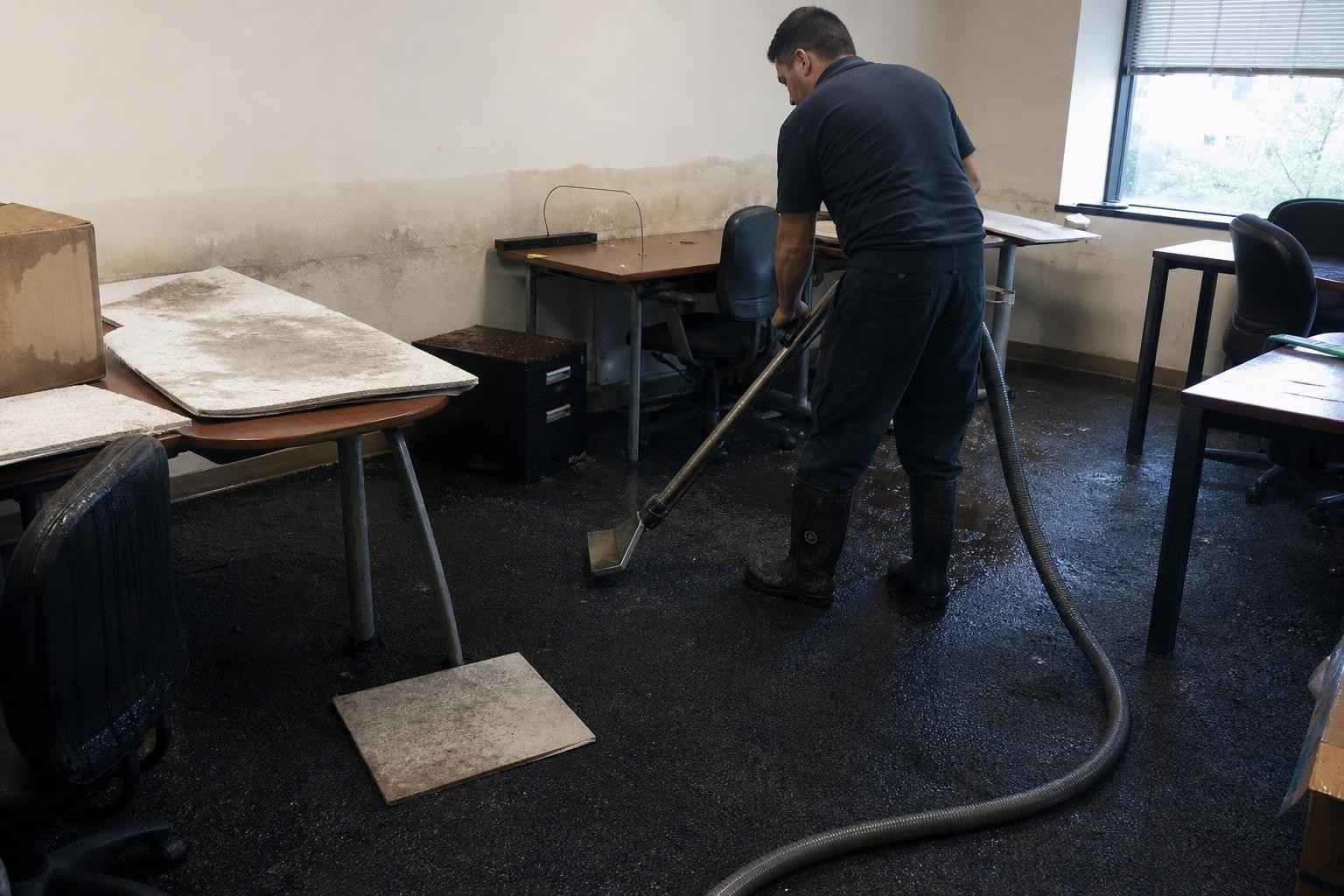
Water damage in Arlington usually traces to slab leaks under Tarrant County clay, aging plumbing in older Pantego and Interlochen homes, or flooding from Rush, Village, and Johnson Creeks draining into Lake Arlington. Our crews extract the water and dry the structure around the clock. Call (469) 804-9910.
Arlington is covered by our Dallas water damage restoration crews, so the same trucks and 24/7 line that work the rest of the metro reach you here.
Water Damage Restoration in Arlington, TX
Water in an Arlington house rarely waits for a convenient moment. A supply line under the sink splits while the family sleeps, a slab leak nibbles through the tile over weeks nobody clocks, or runoff off a Rush Creek storm shoulders its way in under the garage door. From there the pattern is depressingly consistent: it creeps down the baseboards, climbs the paper on the drywall, and slips into the subfloor, where carpet that feels bone dry underfoot hides a soaked layer beneath. Give that a warm Arlington week and mold has its opening within forty-eight hours.
Water Damage Restoration Dallas answers Arlington calls around the clock, and a Sunday at 2 AM gets the same response as a weekday afternoon. Because we run out of Dallas, roughly twenty miles east down I-30, the technician assigned to your address is closing the gap on the interstate instead of setting out cold from the opposite corner of the region. The voice on the line is a person who takes your address and gets a crew rolling, not a recorded menu. Everything the job needs rides along on that first trip: truck-mounted extraction, commercial drying gear, and the photo and meter records an adjuster will want to see. Dial (469) 804-9910 for a straight read on how quickly we can be at your door.
⚠️ Why Arlington Homes Face Elevated Water Damage Risk
Arlington anchors the middle of the DFW Metroplex, and the dirt underneath it explains a lot. Tarrant County's expansive clay puffs up after a wet stretch and shrinks back hard once a Texas drought sets in, and that constant flex chews on the copper and PVC lines poured into your slab. Small wonder slab leaks keep landing near the top of our Arlington dispatch list. Then there is what falls from the sky. The Rush Creek watershed swallowed more than 250 structures when Tropical Storm Hermine came through in 2010, a stretch of them along the creek by Woodland Park, and the city has spent years since buying out and clearing the lots that flood again and again. Add Village Creek, Johnson Creek, and Lake Arlington to the map, mix in a housing stock that runs from 1960s ranch homes around Pantego and Interlochen to the fresh construction rising in Viridian, throw in the winter freeze that cracks an exposed line every few years, and the routes to a wet floor in Arlington start to stack up.
Arlington's Specific Water Damage Risks
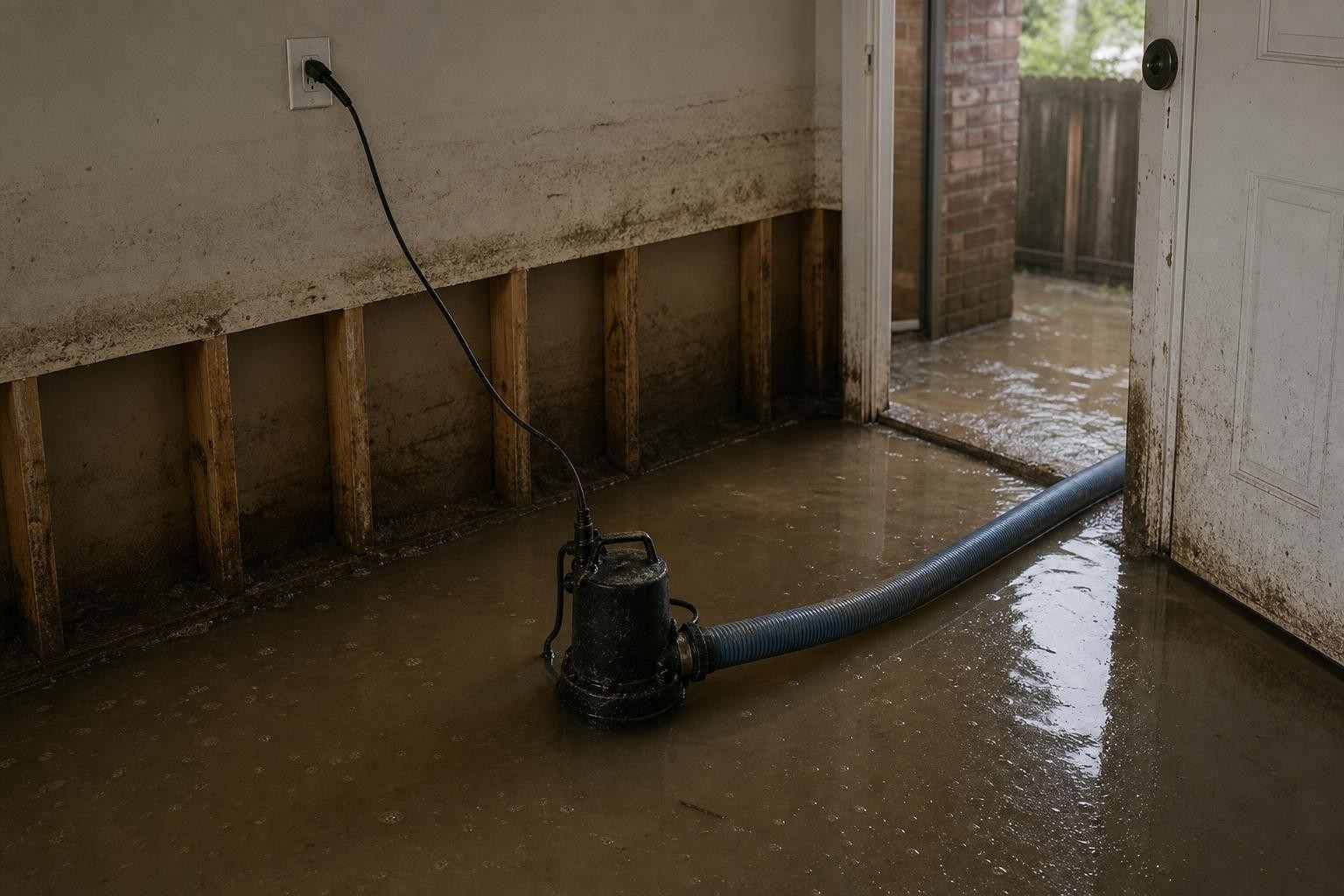
How a floor got soaked shapes how we work it, so pinning the source is where every Arlington job starts. A handful of causes account for most of what pulls our crews across town:
- Creek and stormwater flooding. Rush Creek, Village Creek, and Johnson Creek all wind through Arlington on their way to Lake Arlington, and a hard Texas rain can shove any of them over their banks into the low streets alongside. Woodland Park in 2010 is the corridor people still bring up. Yet you do not need to live on a creek to get wet: a choked storm drain or a block that ponds after a quick downpour can slide water under a door well beyond any mapped flood line.
- Slab leaks under shifting clay. Arlington's clay never truly settles, and the supply lines threaded through your foundation absorb every heave. A patch of floor that stays oddly warm, a water bill drifting upward with no new habits to explain it, or the trickle you catch only when the house falls silent usually traces back to a line already failing below the slab.
- Aging plumbing in the older neighborhoods. Through Pantego, Interlochen, East Arlington, and the blocks around downtown and UTA, houses raised between the 1960s and the 1990s frequently still run their first set of pipe, now thinned by decades of corrosion and quick to throw a pinhole or let a joint go.
- Frozen and burst pipes. Let a North Texas cold snap dig in the way February 2021 did, and the exposed runs are the ones that pay for it: pipe in unheated Arlington garages, attics, and exterior walls freezes solid and splits before the thaw.
- Summer AC condensate overflow. From late spring deep into fall, Arlington air conditioners barely rest. A plugged condensate line or a drain pan rusted through will feed a ceiling or the closet under a second-floor air handler for weeks, and the stain shows up long after the soaking started.
- Appliance and water heater failures. A washer hose that bursts, a dishwasher fitting that weeps, or a water heater near the end of its life can run unattended for hours while the house sits empty, and a heater tucked in the garage can swamp an attached room before anyone gets home.
Water Damage Services We Provide in Arlington
Wherever the water came from, the aim stays fixed: lift it out, restore what it touched, and dry the structure down to a reading a meter will confirm. Here is everything we cover for Arlington property owners.
Water Extraction
Between truck-mounted units and submersible pumps, we empty the standing water from an Arlington home in a sliver of the time a household wet vac would take. Some people call this water mitigation or water cleanup, and it is where every Arlington water restoration and water damage repair job starts.
Water extraction in Arlington TX →24/7 Emergency Water Removal
A line that lets go before dawn or a slab leak inching across the kitchen has no regard for business hours. Reach us any time and a crew starts moving toward Arlington. We take 24 hour water damage calls across Arlington, and that 24/7 water damage line never goes to voicemail.
Emergency water removal in Arlington TX →Flood Damage Restoration
Once Rush Creek or Village Creek tops its banks or the storm drains surrender, a flooded home calls for full extraction, structural drying, and cleanup. We carry Arlington flood jobs from soaked to sound. From flood cleanup through the flood damage repair that follows, we carry a flooded Arlington home from soaked to sound.
Flood damage restoration in Arlington TX →Sewage Cleanup & Sanitization
A sewage backup rates as a Category 3 biohazard, far past what a mop should touch. We wall it off, haul it out, disinfect the whole space, and clear the smell across Arlington. Our sewage backup cleanup covers full sewage removal and black water cleanup.
Sewage cleanup in Arlington TX →Commercial Water Damage
Storefronts, offices, and the venues ringing the Entertainment District and downtown UTA. We get the water off your floor and keep the doors open for business.
Commercial water damage in Arlington TX →Mold Remediation
Dampness trapped in a wall gives mold its opening within a day or two. Our TDLR-licensed partners run containment, removal, and HEPA filtration for Arlington homes.
Mold remediation in Arlington TX →Mold After Water Damage in Arlington
Speed matters so much in Arlington because of what the climate does next. Mold asks for three things, warmth, moisture, and something to root into, and a Tarrant County summer hands over all three at once. Given that, a colony can establish itself inside a day or two of the leak, nearly always behind the drywall or beneath the flooring, where the first clue is a musty smell rather than a visible mark. Extracting the standing water only gets you partway. Leave the deep drying undone and the dampness stays sealed in the wall cavity, quietly working on the framing.
For that reason we treat drying as a full stage of the job, never a token pass with a box fan. Commercial air movers and dehumidifiers run on the structure, and then we come back through with moisture meters and thermal imaging to prove the pockets you cannot see have actually reached dry, not merely the surface a palm can feel. Where mold has already gained ground, our mold remediation partners take on the removal and treatment.
Mold remediation and removal services are performed by or in partnership with a TDLR-licensed Mold Remediation Contractor. We do not perform mold testing, inspection, or assessment, remediation and removal only.
Neighborhoods & ZIP Codes We Serve in Arlington
We take water damage calls all over Arlington TX, from the master-planned streets of Viridian in the north to the older grid near downtown and UTA and out toward the Great Southwest district, every ZIP code, any hour of the day.
Arlington TX Neighborhoods
Arlington TX ZIP Codes
We also serve neighboring Grand Prairie, Fort Worth, Mansfield, Kennedale, and Pantego. View all service areas →
Official Arlington TX Resources