Forney water damage often begins with slab leaks under Blackland Prairie clay that plagues even new builds, burst fittings in the fast-growing Devonshire and Gateway Parks tracts, and Buffalo Creek flooding after Kaufman County storms. Our crews extract the water and dry the framing. Call (469) 804-9910 for 24/7 emergency response.
In Forney, you get our Dallas water damage restoration service, the same crew day or night.
Water Damage Restoration in Forney, TX
Most Forney water calls start the same way: a homeowner who moved into a shiny new build in Devonshire or Gateway Parks a couple of years ago, never expecting to hunt for a shutoff valve in the dark. Then a supply fitting behind the washer lets go, or a line cast into the slab starts to seep, or Buffalo Creek climbs after a Kaufman County storm rolls through. The water finds the laminate first, then the baseboards, and it keeps traveling as long as it is left alone.
Water Damage Restoration Dallas takes those calls day or night, weekends and holidays too. We work out of Dallas, roughly 23 miles up U.S. 80, so the technician sent your way is running the corridor toward you rather than crawling in from the far side of the county. A real person answers, gathers the details, and rolls a crew carrying truck-mounted extraction, drying equipment, and the camera and meters your adjuster will ask about later. Call (469) 804-9910 and we will tell you straight how quickly we can be at your door.
⚠️ Why Forney Homes Face Elevated Water Damage Risk
The trouble starts in the ground. Forney sits on the Texas Blackland Prairie, and that heavy black clay barely lets water through. It swells fat after a downpour, then shrinks and cracks as a brutal summer bakes it dry, and every one of those swings pulls on the water lines threaded through the foundation. That is the short version of why slab leaks stay near the top of our Forney work, even on houses barely out of the builder's hands. Add a population that has close to doubled since 2020, a housing stock that runs from the old streets by downtown to whole master-planned tracts framed in a single season, two creeks moving storm runoff through town, and the odd deep freeze, and there is more than one way for a Forney floor to end up underwater.
Why Water Damage Hits Forney Hard
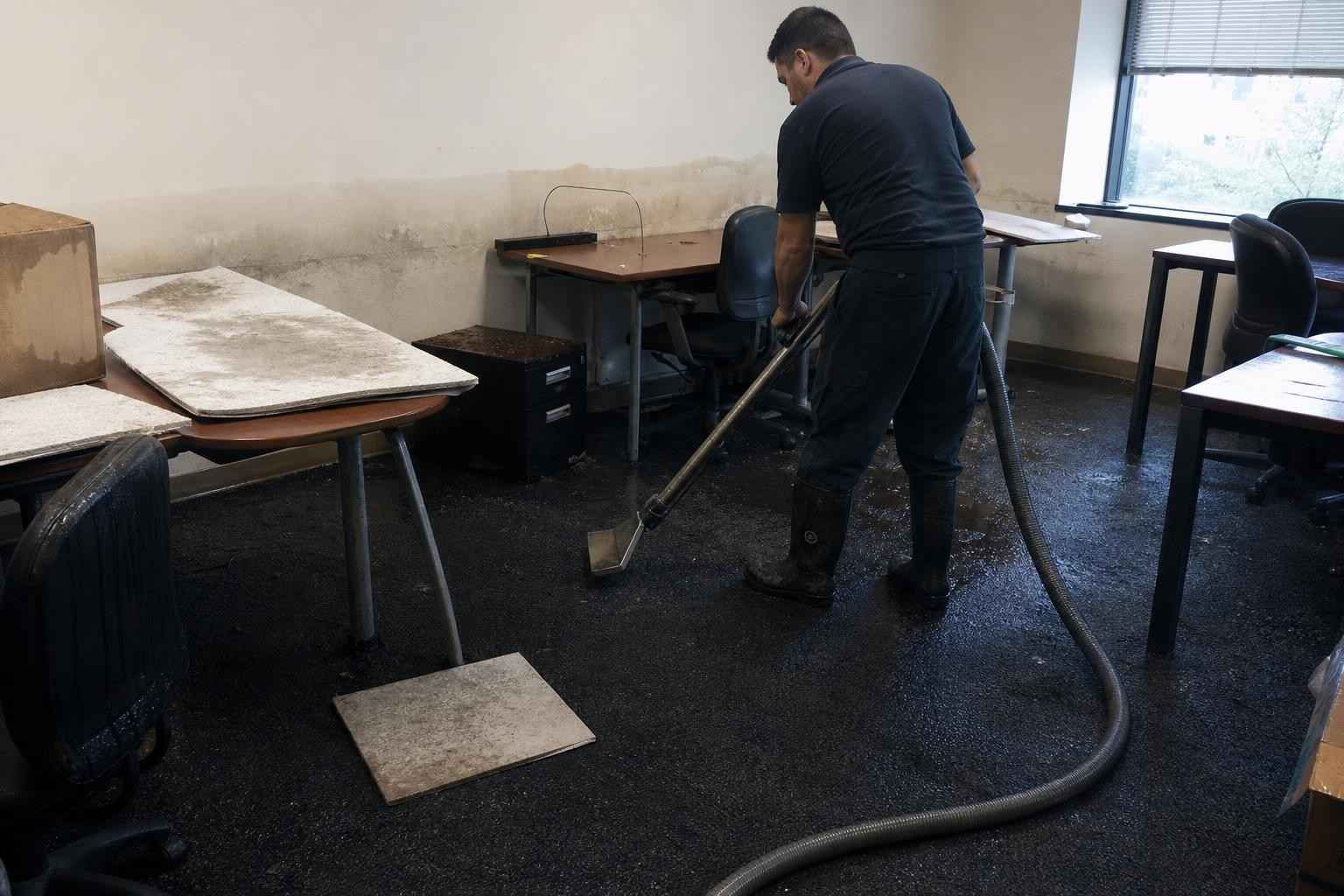
Geology does a lot of the damage here before weather ever gets a vote. The expansive blackland clay under Forney is in constant slow motion, and the supply lines buried in your slab ride along with it. Over enough seasons a joint gives, and the first hint is usually subtle: a patch of floor that stays oddly warm, a water bill creeping up for no reason, or the faint sound of water moving when every faucet is off. Because so much of the town went up in the last handful of years, we also see the flip side of a building boom, young plumbing failing early from a loose fitting, a line nicked during construction, or a part that was never right to begin with.
Then there is the water that comes from outside. Buffalo Creek and Mustang Creek both push runoff north toward the East Fork of the Trinity, and a hard local rain can shove either channel up into the low ground beside it. The city itself notes that its mapped floodplain does not fully account for the extra runoff all the new rooftops and pavement send downstream, so more homes sit near that line than an older map lets on. Between the creeks, the clay, a February freeze every few winters, and air conditioners that run flat out from spring into fall, a Forney homeowner has a fair number of paths to a wet house.
Common Forney Water Emergencies We Get Called For
Different sources leave water in a house in very different ways, and around Forney a handful of them account for most of the emergency calls that reach us. These are the ones our crews see again and again:
- A slab leak that has been quietly running for weeks. The blackland clay shifts, a line beneath the foundation splits, and the water spreads under the tile long before anyone spots it. By the time a Travis Ranch or Clements Ranch owner calls, the subfloor is already saturated in one corner of the house.
- A washer or water heater that let go while nobody was home. A cracked supply hose or a tank at the end of its life can run for hours across an empty Devonshire two-story, and a full heater sends a lot of water across a lot of flooring before anyone walks back in.
- Buffalo Creek pushing water into a low-lying yard after a storm. When a Kaufman County cloudburst overwhelms the drains, homes near the creek and the streets that pond behind Windmill Farms can take water under a door or up through the garage.
- A pipe split by a hard North Texas freeze. The way the February 2021 storm proved, it is the exterior walls and cold attics of Forney's newer builds where a line is most likely to burst when the temperature crashes and then thaws.
- An upstairs AC drain overflowing in the heat of August. Run an air handler hard through a Forney summer and a clogged condensate line or a rusted pan spills over, staining a ceiling and soaking the closet below well before the household notices the drip.
Water Damage Services We Provide in Forney
However the water got in, the work runs the same direction: pull it out, save what can be saved, and dry the structure down until a meter agrees it is dry. Here is the full slate we cover for Forney property owners.
Water Extraction
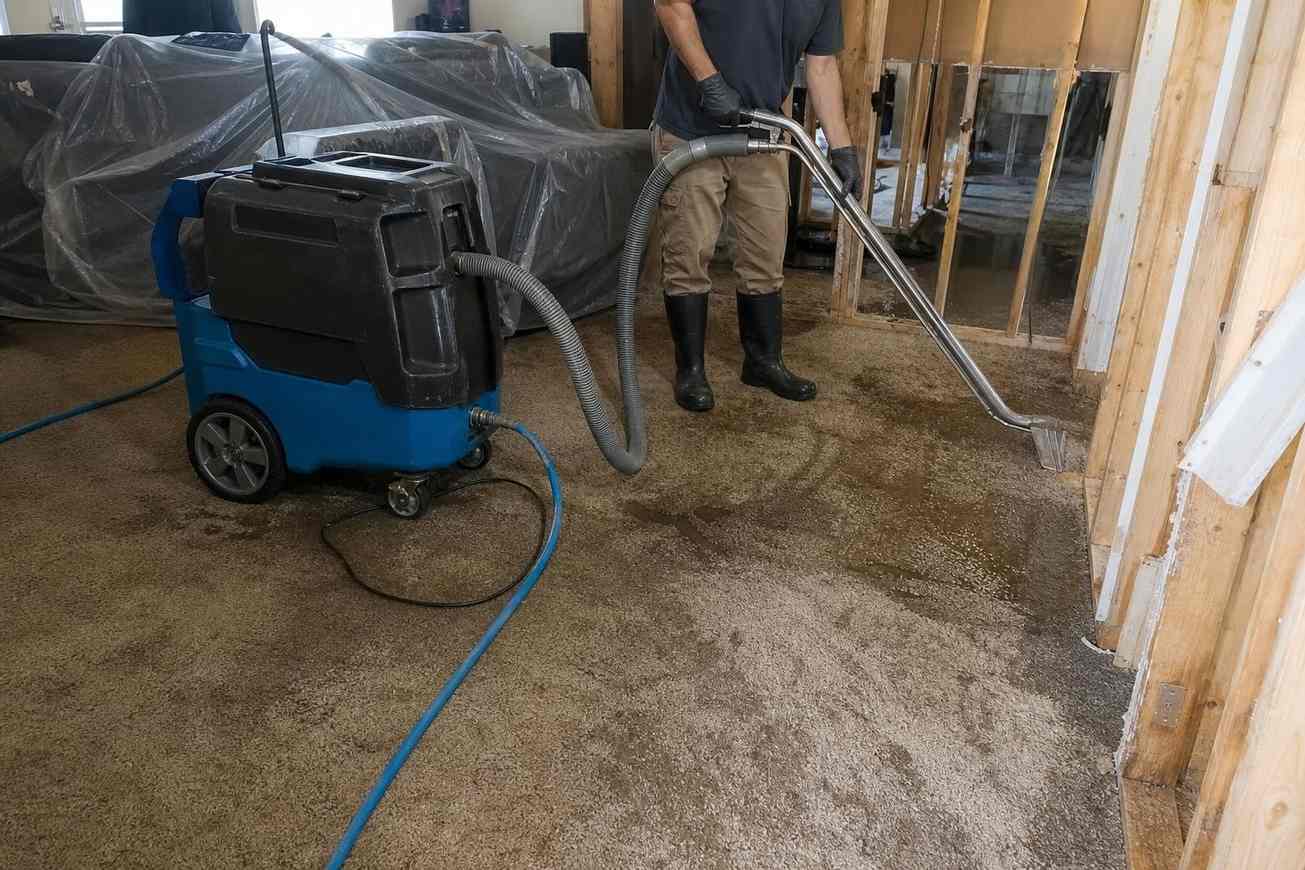
Truck-mounted extractors and submersible pumps empty a Forney home of standing water far quicker than any household wet-vac could hope to keep up with. Some people call this water mitigation or water cleanup, and it is where every Forney water restoration and water damage repair job starts.
Water extraction in Forney TX →24/7 Emergency Water Removal
A supply line that splits before dawn in a Devonshire two-story, or a slab leak crawling across the kitchen, has no interest in business hours. We answer around the clock and head for Forney. We take 24 hour water damage calls across Forney, and that 24/7 water damage line never goes to voicemail.
Emergency water removal in Forney TX →Flood Damage Restoration
When Buffalo Creek jumps its banks or the storm drains back up, a flooded home needs full extraction, structural drying, and cleanup. We take Forney flood jobs from soaked to sound. From flood cleanup through the flood damage repair that follows, we carry a flooded Forney home from soaked to sound.
Flood damage restoration in Forney TX →Sewage Cleanup & Sanitization
A backed-up sewer line counts as a Category 3 biohazard, well past anything a mop can touch. We contain it, haul it out, disinfect the space, and clear the odor across Forney. Our sewage backup cleanup covers full sewage removal and black water cleanup.
Sewage cleanup in Forney TX →Commercial Water Damage
Storefronts, offices, and the businesses strung along the U.S. 80 and FM 548 corridors. We clear the water off your floor and help you keep the doors open.
Commercial water damage in Forney TX →Mold Remediation
Moisture left behind in a wall feeds mold within a day or two. Our TDLR-licensed partners run the containment, removal, and HEPA filtration for Forney homes.
Mold remediation in Forney TX →Mold After Water Damage in Forney
The reason we move fast in Forney comes down to the local climate more than anything else. Mold needs only three things to take hold, warmth, moisture, and a surface to grow on, and a Kaufman County summer hands it all three for free. Under those conditions a colony can set up inside 24 to 48 hours of a leak, and it almost always chooses the hidden spots first, behind the drywall or beneath the flooring, where you smell it before you ever see it. Getting the standing water out is only part of the fight. Walk away before the structure is fully dried and all you have done is trap the dampness inside the wall, where it keeps chewing on the framing.
So on a Forney job the drying is treated as real work, not a box to tick. We put air movers and dehumidifiers on the structure, then come back through with moisture meters and thermal imaging to make sure the pockets you cannot reach by hand have actually dried out and not just the surface. If mold has already taken hold, our mold remediation partners step in for the removal and treatment.
Mold remediation and removal services are performed by or in partnership with a TDLR-licensed Mold Remediation Contractor. We do not perform mold testing, inspection, or assessment, remediation and removal only.
Neighborhoods & ZIP Codes We Serve in Forney
We take water damage calls all across Forney TX, from the historic streets around downtown and U.S. 80 to the sprawling new master-planned communities on the east and south sides, every part of ZIP 75126, any hour of the day.
Forney TX Neighborhoods
Forney TX ZIP Codes
We also serve neighboring Mesquite, Sunnyvale, Terrell, Talty, and Seagoville. View all service areas →
Official Forney TX Resources