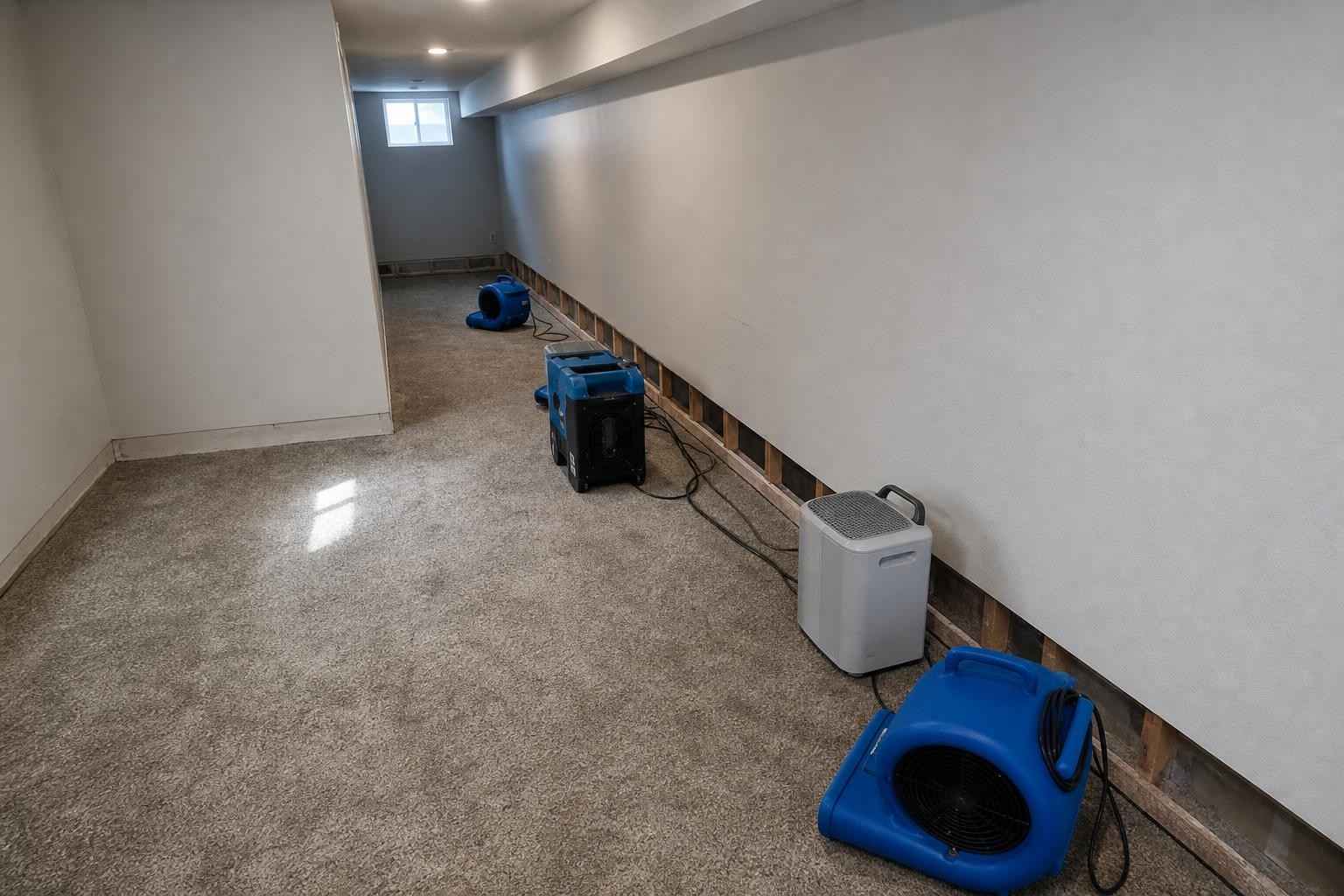
Flower Mound sits between Grapevine and Lewisville Lakes, so homes flood through the Denton and Elm Fork watersheds, and slab leaks under expansive clay stress the 20 to 35 year old plumbing in its 1990s and 2000s master-planned houses. We extract the water and dry the structure. Call (469) 804-9910 for 24/7 response.
We serve Flower Mound through our Dallas water damage restoration response, which puts the same equipment and around the clock dispatch at your door.
Water Damage Restoration in Flower Mound, TX
Around Flower Mound the trouble usually begins in a spot nobody checks. Overnight a supply line quietly splits behind a Bridlewood laundry wall, a slab leak edges up through the tile of a home off Morriss Road, or a hard rain sheeting toward Grapevine Lake forces water back up through a floor drain. From there it will not hold still. Water threads along the baseboards, creeps up the paper backing of your drywall, and settles into the subfloor while the carpet on top still feels bone dry. Give the muggy Denton County air a day or two after that, and mold has everything it needs to move in.
Flower Mound calls reach Water Damage Restoration Dallas at any hour, weekends and holidays no exception. Home base for us is Dallas, about 28 miles to the southeast, and this corner of Denton County already sits on our regular run, so the technician sent your way is aiming at a town we work rather than one we have to map out first. Dial in and a live voice answers, then a crew heads out with truck-mounted extraction, commercial drying gear, and the photo and meter records your adjuster will look for, the whole job covered on a single trip. Call (469) 804-9910 for a straight answer on how fast we can reach you.
⚠️ Why Flower Mound Homes Face Elevated Water Damage Risk
Flower Mound is wedged between two big reservoirs, Grapevine Lake to the south and Lewisville Lake to the north, and the town drains toward both through the Denton and Elm Fork Trinity watersheds. That geography puts real flood exposure on the low ground near the water and the creeks feeding it, and the town's own floodplain office points out that local drainage can flood homes sitting nowhere near a mapped creek. Below the surface sits the heavy clay soil that runs across most of the Metroplex, swelling after a wet spell and pulling back tight in a dry one, which keeps steady stress on the supply lines cast into your slab. On top of that, most of Flower Mound went up as master-planned housing through the 1990s and 2000s, so a big share of homes now carry plumbing 20 to 35 years old, right at the age where copper joints and supply lines start to give. Stir in the hard January freezes and air conditioners that run flat out all summer, and a Flower Mound homeowner has more than one route to a wet floor.
Flower Mound's Specific Water Damage Risks
Where the water started tells us how the cleanup has to run, and around Flower Mound a handful of causes come up again and again. These are the jobs that pull our crews out here the most:
- Lake and creek flooding. Flower Mound maps its flood hazard areas along channels like Timber Creek, Wichita Creek, McKamy Creek, Bakers Branch, and Sharps Branch, along with the low ground that rings Grapevine Lake. Let a heavy North Texas downpour land, or the Corps open the gates on the lakes, and those channels can spill into the yards beside them. Since the town warns that flooding ignores the mapped line, a street that ponds or a clogged storm inlet can slide water under a door blocks away from any creek.
- Slab leaks under a moving foundation. Underneath Flower Mound the clay is forever shifting, and the water lines cast into your slab wear every bit of that motion. Catch a patch of floor that stays warm, a water bill that climbs for no reason you can name, or a faint hiss only audible once the house goes still, and odds are a line below has already given out.
- Aging pipe in the master-planned neighborhoods. Plenty of the Flower Mound homes raised through the 1990s and 2000s are still plumbed with their original supply lines, and two or three decades in, that pipe thins, corrodes, and starts letting go at the joints.
- Frozen and burst lines. Let a cold front settle over North Texas the way the February 2021 storm did, and it is the exposed pipe in unheated attics, garages, and outside walls that tends to crack first across Flower Mound.
- AC condensate spillover in summer. Push an air conditioner straight through a Flower Mound July and sooner or later a plugged condensate line or a corroded drain pan overflows, soaking a ceiling or a closet under a second-floor air handler without a sound.
- Appliance and water heater failures. A split ice-maker line, a loose dishwasher fitting, or a water heater near the end of its run can pour water for hours with nobody home to notice.
Water Damage Services We Provide in Flower Mound
No matter what let the water in, the plan stays the same: get it out, salvage what it reached, and dry the structure down to a reading a meter can back up. Here is the full slate we cover for Flower Mound property owners.
Water Extraction
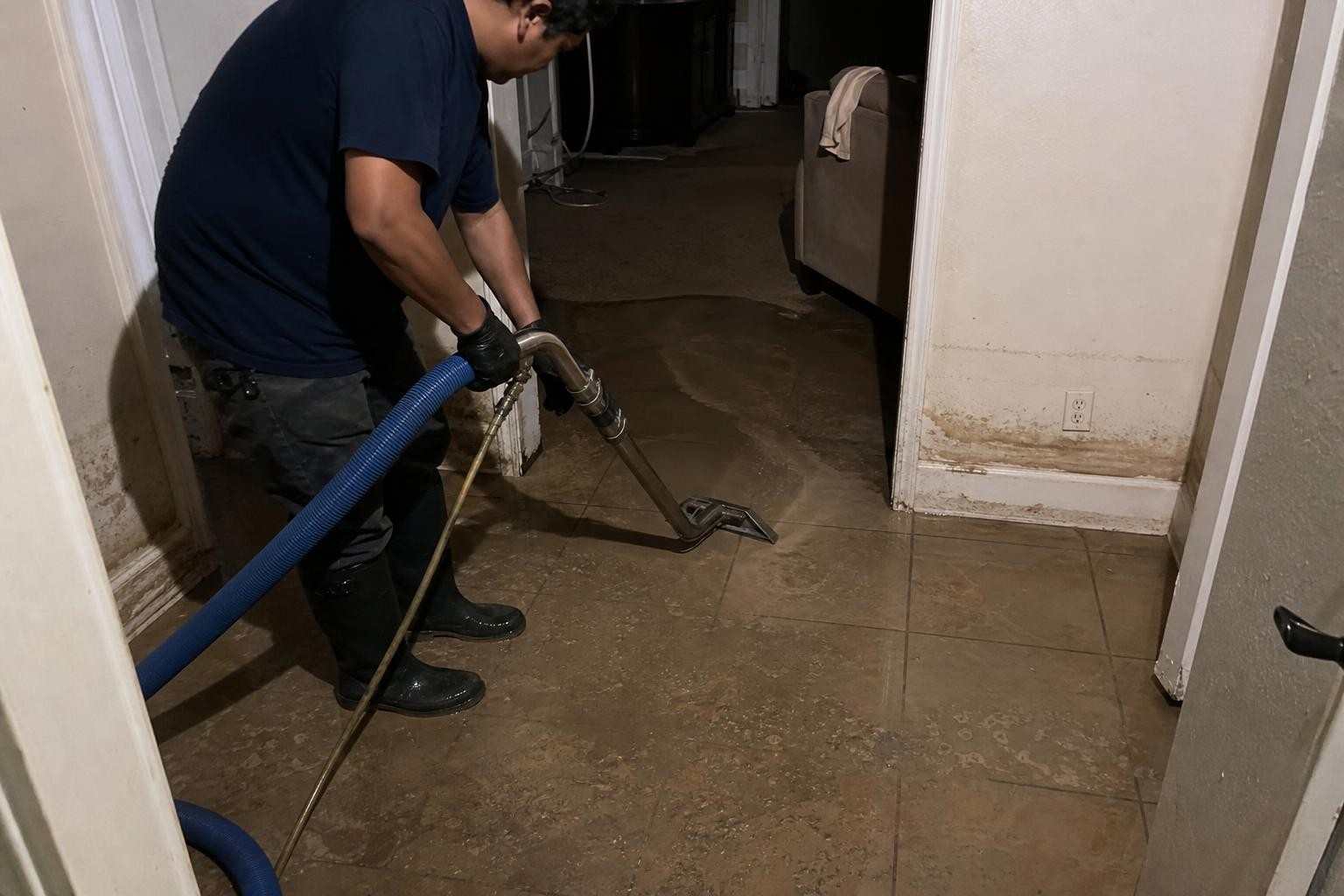
Truck-mounted extractors and submersible pumps empty a flooded Flower Mound home in a sliver of the time a household wet-vac would ever manage. Some people call this water mitigation or water cleanup, and it is where every Flower Mound water restoration and water damage repair job starts.
Water extraction in Flower Mound TX →24/7 Emergency Water Removal
A pipe that lets go before dawn or a slab leak inching across the kitchen has no patience for business hours. We answer whenever you call and point a crew at Flower Mound. We take 24 hour water damage calls across Flower Mound, and that 24/7 water damage line never goes to voicemail.
Emergency water removal in Flower Mound TX →Flood Damage Restoration
Let the creeks jump their banks or Grapevine Lake push into low ground, and a flooded home needs full extraction, structural drying, and cleanup. We carry Flower Mound flood jobs from soaked to sound. From flood cleanup through the flood damage repair that follows, we carry a flooded Flower Mound home from soaked to sound.
Flood damage restoration in Flower Mound TX →Sewage Cleanup & Sanitization
When a sewer line backs up into a Flower Mound home, the Category 3 water it brings is a biohazard well beyond anything a mop should touch. We contain it, haul it out, disinfect the space, and clear the odor. Our sewage backup cleanup covers full sewage removal and black water cleanup.
Sewage cleanup in Flower Mound TX →Commercial Water Damage
Shops and offices along FM 2499 and the Long Prairie Road corridor. We lift the water off your floor and help keep the doors open for business.
Commercial water damage in Flower Mound TX →Mold Remediation
In Flower Mound's lake-fed humidity, moisture left in a wall gives mold its start inside a day or two. Our TDLR-licensed partners run containment, removal, and HEPA filtration.
Mold remediation in Flower Mound TX →Mold After Water Damage in Flower Mound
Sitting between Grapevine and Lewisville lakes gives Flower Mound air that stays heavy through the warm months, and that lake-fed humidity is precisely what mold feeds on. Leave a leak damp in a Bridlewood wall and a colony can take hold within a day or two, nearly always behind drywall or under flooring where the smell reaches you before your eyes do. Lifting the standing water is only the first move. Skip the deep drying after that and you have simply sealed the dampness into the wall, where it keeps working on the framing.
So on a Flower Mound job drying is a stage of its own, not a quick wipe-down. The structure sits under air movers and dehumidifiers, and we work back through it with moisture meters and thermal imaging to prove the hidden pockets have truly dried, not just the surface your hand can find. Where mold has already taken hold, our mold remediation partners step in to handle the removal and treatment.
Mold remediation and removal services are performed by or in partnership with a TDLR-licensed Mold Remediation Contractor. We do not perform mold testing, inspection, or assessment, remediation and removal only.
Neighborhoods & ZIP Codes We Serve in Flower Mound
We answer water damage calls everywhere in Flower Mound TX, from the Bridlewood golf community and the older streets off Morriss Road out to the newer builds edging toward Argyle, every ZIP code, every hour of the day.
Flower Mound TX Neighborhoods
Flower Mound TX ZIP Codes
We also serve neighboring Lewisville, Highland Village, Grapevine, Coppell, and Argyle. View all service areas →
Official Flower Mound TX Resources