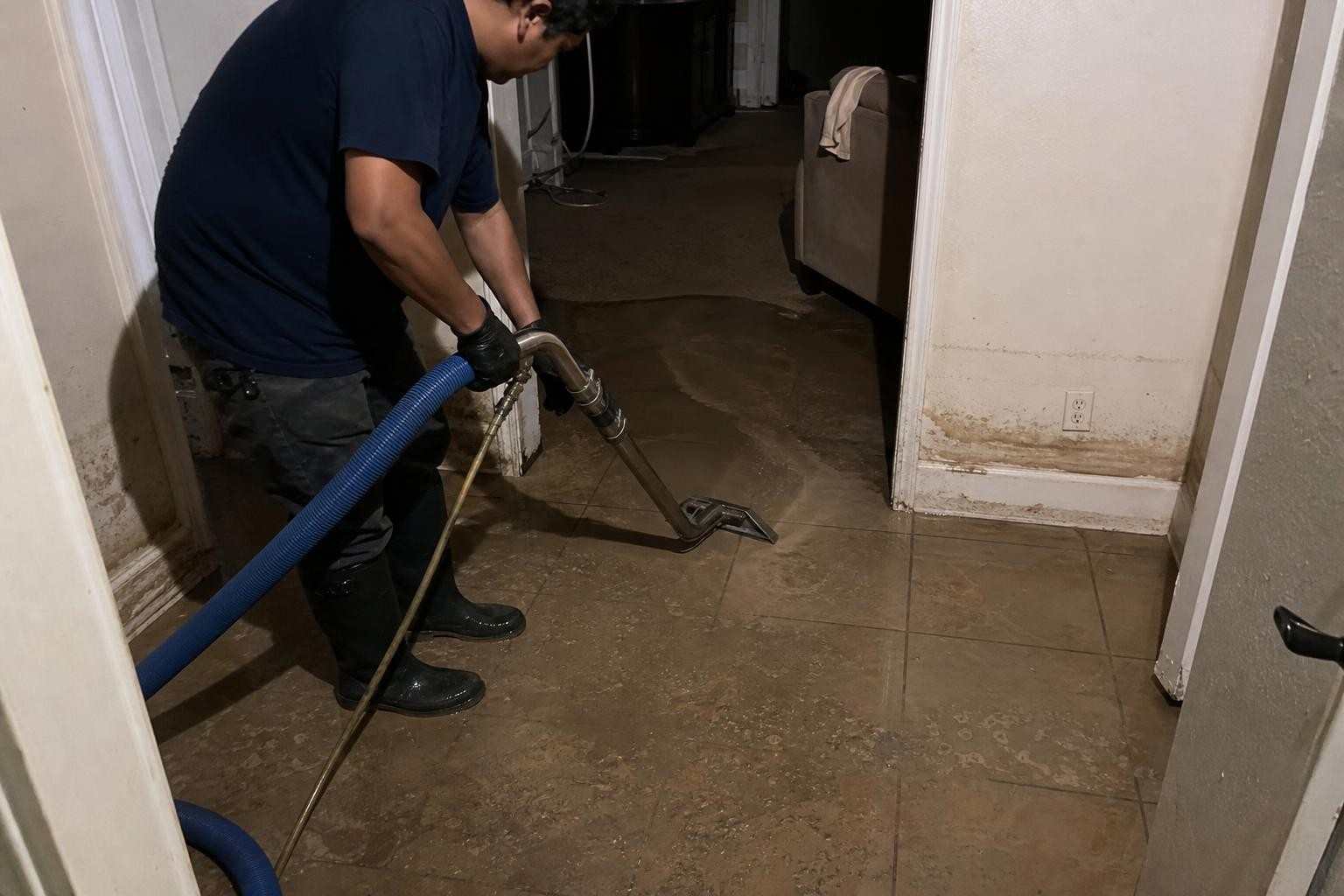
Garland stacks several water risks: flooding along Duck, Rowlett, and Spring Creek toward Lake Ray Hubbard, roughly 4,200 acres of 100-year floodplain, 50-year-old pipe in 1960s to 1980s homes, and slab leaks under eastern Dallas County clay. We extract and dry the structure fast. Call (469) 804-9910 for 24/7 response.
Garland leans on our citywide water damage restoration in Dallas for fast dispatch, moisture verified drying, and claim documentation.
Water Damage Restoration in Garland, TX
Water rarely announces itself politely in a Garland house. A supply line lets go behind a wall in a Camelot ranch while everyone sleeps, a slab leak that spent months chewing on a copper joint finally pushes up through the floor near Duck Creek, or a downpour off Lake Ray Hubbard overwhelms a storm drain and pools across the den. From there it stops being a puddle and starts being a problem, creeping along baseboards, climbing the paper face of the drywall, and settling into the subfloor while the carpet you can see still feels perfectly fine.
Water Damage Restoration Dallas answers the phone for Garland around the clock, holidays and 2 a.m. Sundays included. Because Garland shares a border with Dallas and our shop sits a short run southwest, the technician we send is heading toward you instead of setting out from the far side of the county. A real person picks up, and the crew arrives ready on the first trip with truck-mounted extraction, commercial drying gear, and the photo and meter records your adjuster is going to ask for. Call (469) 804-9910 and we will give you a straight answer on how soon we can be at the door.
⚠️ Why Garland Homes Face Elevated Water Damage Risk
What makes Garland tricky is how many separate water risks pile onto one map. Three creeks thread the city, Duck Creek, Rowlett Creek, and Spring Creek, and the floodplain traced along them and their branches covers roughly 4,200 acres of 100-year zone. The channel-widening work done on Duck Creek in the late 1990s pulled a fair number of homes back from the edge, yet plenty still sit within reach of high water. Add the era Garland was built, mostly the 1960s through the 1980s, and a large share of homes still run pipe that is fifty years old or more, thinned and quick to fail at the joints. Under all of it lies the heavy expansive clay of eastern Dallas County, soil that swells in the rain and shrinks in a drought, leaning on the lines cast into your slab. Fold in the deep freezes and the storms that spin up over this stretch of the Metroplex, the same violent setup behind the deadly December 2015 tornado near Lake Ray Hubbard, and one Garland address can face water trouble from several directions at once.
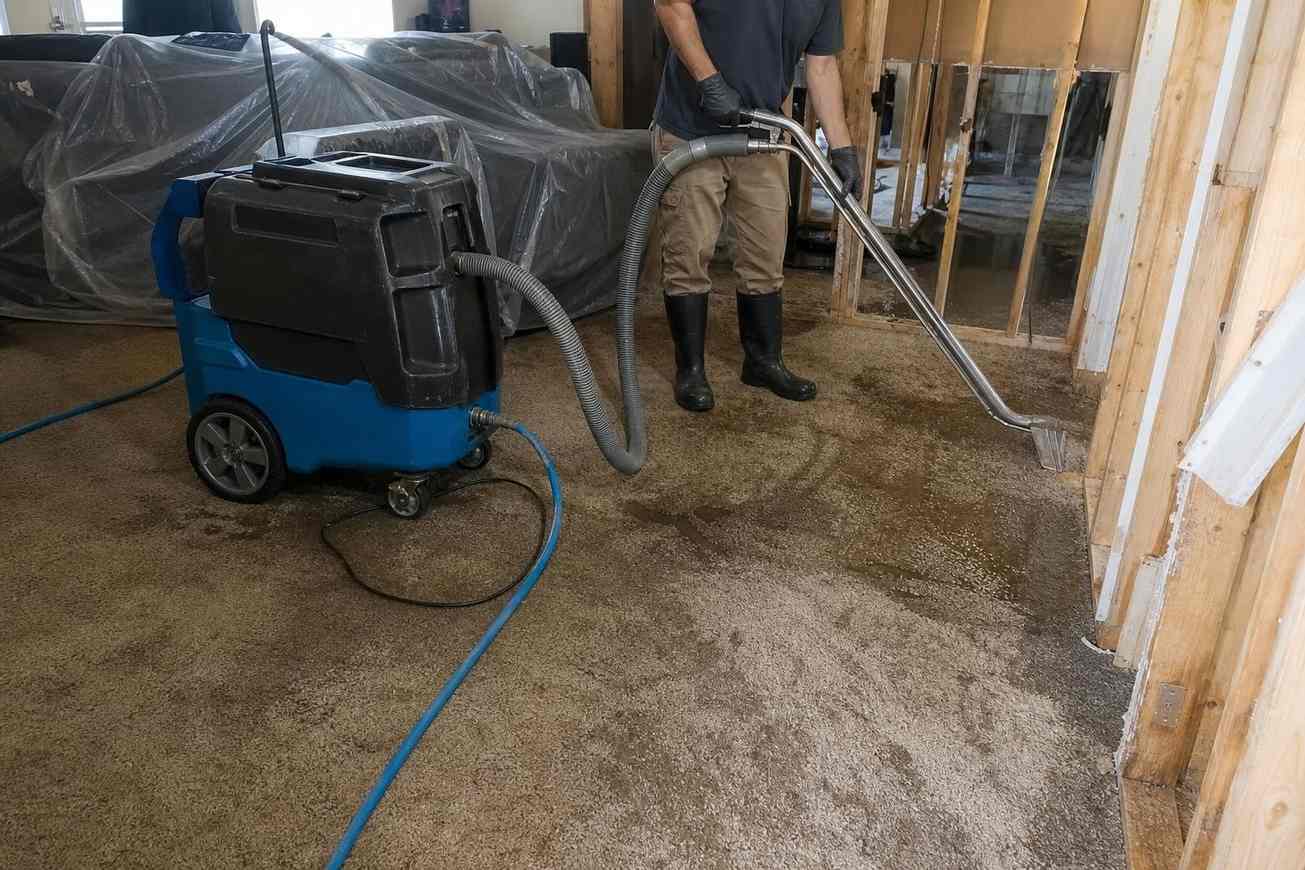
Why Water Trouble Stacks Up in Garland
The cause is what steers the whole job, so it is the first thing we settle on site. In Garland the trouble usually starts underground. That black eastern Dallas County clay never really sits still, and the lines cast into your foundation take the strain of every wet-then-dry cycle. A slab leak rarely shows itself as a gush; it reads as a patch of floor that stays oddly warm, a water bill drifting up for no reason, or a faint trickle you only notice once the house goes quiet. By the time it surfaces, the water has often been under there for weeks.
Weather works the house from the other end. When a hard freeze settles in the way the February 2021 storm did, the pipes in Garland attics, garages, and exterior walls are the ones that split. When the sky opens instead, Duck Creek, Rowlett Creek, and Spring Creek can shove past their banks into the low ground alongside, and the paved runoff that all drains toward Spring Creek and Lake Ray Hubbard can back up a choked inlet and slide water under a door well outside any flagged flood line.
The house itself contributes plenty too. So much of Garland dates to the 1960s through the 1980s that homes around Downtown, Camelot, and the Duck Creek pockets frequently still run their original supply lines, now corroded and splitting at the seams. Add the air conditioners that grind on for months of North Texas summer, a condensate line that clogs or a drain pan that rusts through, and a slow feed can wet a ceiling for days before any stain appears.
Common Garland Water Emergencies We Get Called For
Over the years the same handful of Garland calls come back again and again. These are the ones that fill our phone:
- The overnight slab leak near Duck Creek. A homeowner wakes to a warm spot underfoot and a hiss under the floor, and by morning the line beneath the foundation has surfaced through the tile.
- A creek-side backyard that floods after a Lake Ray Hubbard storm. Rowlett or Spring Creek climbs, the storm drain gives out, and water pushes through the back door into a home that sits well below any mapped flood line.
- The burst attic line in an older Camelot home. A deep freeze cracks a supply pipe run through an uninsulated attic, and the thaw sends it raining down through the ceiling into the rooms below.
- A sewer backup in a Downtown Garland house on original plumbing. Decades-old clay drain lines choke or collapse, and Category 3 water comes up through the lowest fixtures in the home.
- The AC condensate overflow in a Firewheel two-story. A clogged condensate line quietly feeds an upstairs air handler closet through the peak of summer until the water finally stains the ceiling on the floor below.
Water Damage Services We Provide in Garland
Whatever put the water in the house, the aim stays fixed: lift it off the floor, salvage what it reached, and dry the structure down to a number a meter can confirm. Here is the full range we run for Garland property owners.
Water Extraction
Truck-mounted extractors paired with submersible pumps clear a flooded Garland home far faster than the shop vac in your garage ever could, whether the source is a Duck Creek slab leak or a storm-driven backup. Some people call this water mitigation or water cleanup, and it is where every Garland water restoration and water damage repair job starts.
Water extraction in Garland TX →24/7 Emergency Water Removal
A line that lets go before sunrise or a slab leak edging across the kitchen has no interest in waiting for morning. We pick up at any hour and head straight for Garland. We take 24 hour water damage calls across Garland, and that 24/7 water damage line never goes to voicemail.
Emergency water removal in Garland TX →Flood Damage Restoration
When Duck Creek or Rowlett Creek rises and the storm drains give out, a flooded home needs the full run of extraction, drying, and cleanup. We take Garland flood jobs from soaked to sound. From flood cleanup through the flood damage repair that follows, we carry a flooded Garland home from soaked to sound.
Flood damage restoration in Garland TX →Sewage Cleanup & Sanitization
When decades-old clay drain lines in a Downtown Garland home give out, the Category 3 water that comes up is a biohazard no mop belongs near. We contain it, haul it out, disinfect the space, and clear the odor. Our sewage backup cleanup covers full sewage removal and black water cleanup.
Sewage cleanup in Garland TX →Commercial Water Damage
Storefronts, offices, and the retail clustered around the Firewheel Town Center corridor. We clear the water off your floor and help keep the doors open.
Commercial water damage in Garland TX →Mold Remediation
In Garland's creek-fed humidity, dampness left in a wall cavity gives mold its opening within a day or two. Our TDLR-licensed partners run the containment, removal, and HEPA filtration for Garland homes.
Mold remediation in Garland TX →Mold After Water Damage in Garland
Speed matters on a Garland job for one reason: the Duck Creek humidity. Warm, damp air rolling off the creek corridors and Lake Ray Hubbard hands mold the exact conditions it wants, and a colony can be growing behind a Camelot ranch wall within a day or two of the leak, tucked out of sight in the cavity where the only early warning is a musty smell. Extracting the standing water clears the visible half of the problem. Leave the framing damp behind the drywall, though, and you have simply locked the moisture inside a wall that keeps feeding rot.
Because of that, we run drying as a distinct phase of the Garland job rather than a quick pass with a fan. The structure sits under air movers and dehumidifiers, then we verify with moisture meters and thermal imaging that the pockets a hand can never reach have truly dried out, not just the surface. If a Garland home already has mold established, our mold remediation partners take over the containment, removal, and treatment.
Mold remediation and removal services are performed by or in partnership with a TDLR-licensed Mold Remediation Contractor. We do not perform mold testing, inspection, or assessment, remediation and removal only.
Neighborhoods & ZIP Codes We Serve in Garland
We take water damage calls right across Garland TX, from the master-planned streets around Firewheel on the northeast side to the older homes strung along Duck Creek and around Downtown, in every ZIP code and at any hour of the day.
Garland TX Neighborhoods
Garland TX ZIP Codes
We also serve neighboring Rowlett, Sachse, Richardson, Mesquite, and Sunnyvale. View all service areas →
Official Garland TX Resources