Water damage restoration in Richardson, TX means pumping out water and drying homes after flooding from Duck, Cottonwood, Prairie, or Huffhines Creek, plus slab leaks on expansive clay. Roughly 40 percent of houses date to the 1970s, so worn supply lines near Canyon Creek and Richardson Heights drive many of the calls.
Richardson sits inside our full water damage restoration service in Dallas, so the pumps and dehumidifiers that answer across Dallas answer here.
Water Damage Restoration in Richardson, TX
Richardson runs on a lot of aging plumbing, and aging plumbing rarely fails at a convenient hour. A copper line behind a Canyon Creek wall lets go around 2 a.m., a slab leak works its way up through the hallway tile after weeks nobody could hear, or a Telecom Corridor cloudburst pushes Duck Creek past its banks and into a low backyard. However it begins, the clock starts immediately. The water wicks along the baseboards, soaks up into the sheetrock, and drops down into the subfloor and framing that nobody thinks to check. Give it a warm North Texas afternoon or two and mold has already claimed the space.
Richardson emergencies reach a live person at Water Damage Restoration Dallas whatever the hour, weekends and holidays no exception. Our shop sits about fifteen miles south in Dallas, which means the technician assigned to you is already heading up toward Richardson rather than starting the drive from the far edge of the Metroplex. No phone tree stands between you and help, and the crew arrives on that first trip with truck-mounted extraction, commercial drying equipment, and the photos and moisture readings your adjuster will end up asking for. Call (469) 804-9910 and you will hear honestly how soon a crew can reach your door.
⚠️ Why Richardson Homes Face Elevated Water Damage Risk
Much of what goes wrong in Richardson plumbing traces back to the era the city was built. Richardson took shape in the 1950s as a bedroom community for the Texas Instruments engineers arriving with the electronics boom, and midcentury ranch homes still define neighborhoods like Canyon Creek, Heights Park, and Richardson Heights. About four in ten houses here date to the 1970s, so a large share of the local housing stock now depends on supply lines somewhere between 45 and 70 years old, right in the window where fittings and joints begin to fail. Underneath sits the expansive clay common to Dallas and Collin counties, soil that swells after a soaking rain and contracts hard through a Texas drought, pulling steadily on the water lines routed through your slab. That constant flex is what keeps slab leaks near the top of our Richardson call log. Layer on the four creeks winding through town, the occasional deep freeze that ruptures exposed pipe, and the packed office space along the Telecom Corridor, and any Richardson property has several separate routes to a wet floor.
Richardson's Specific Water Damage Risks
Because the source dictates the method, pinning down where the water came from is our first job on any Richardson call. A handful of scenarios account for most of what we see:
- Creek and stormwater flooding. Four creeks lace through Richardson, Duck, Cottonwood, Prairie, and Huffhines, and a hard downpour can back any of them up into the homes sitting low along the greenbelts. The city carries runoff through more than 10,000 inlets, 350 plus miles of storm drain, and close to 45 miles of open creek channel, but let a storm overrun an inlet or push a creek out of its banks and a yard with no history of flooding can take on water in minutes.
- Slab leaks under a moving foundation. The clay under Richardson never fully settles, and the pressurized lines threaded through your slab wear the strain. A patch of floor that stays warm underfoot, a water bill that climbs with no explanation, or a thin running-water sound in an otherwise silent house usually means a line below has already given way.
- Worn-out plumbing in the mid-century streets. Through Canyon Creek, Heights Park, and the older blocks near J.J. Pearce, houses from the 1950s and 1960s often still run their original supply lines, by now thinned by corrosion and quick to throw pinholes or split at a joint.
- Frozen and burst lines. Let a North Texas cold snap dig in, as the February 2021 storm proved, and the first pipes to split in Richardson are the ones in unheated attics, garages, and exterior walls, with the thinly insulated older homes taking the hardest hit.
- Summer AC condensate overflow. Richardson air handlers grind on for months without a real break. A clogged condensate line or a rusted drain pan can drip unnoticed into a ceiling or closet, frequently beneath a second-floor unit, until the stain finally shows.
- Appliance, water heater, and commercial failures. Washer hoses, dishwasher fittings, and worn water heaters give out with no warning. Along the Telecom Corridor and around CityLine, a ruptured line in an office or retail suite can run the entire weekend with no one on site to catch it.
Water Damage Services We Provide in Richardson
Wherever the water started, the objective never shifts: clear it out, salvage what it touched, and take the structure down to a moisture number we can prove with a meter. Below is everything we handle for Richardson property owners.
Water Extraction
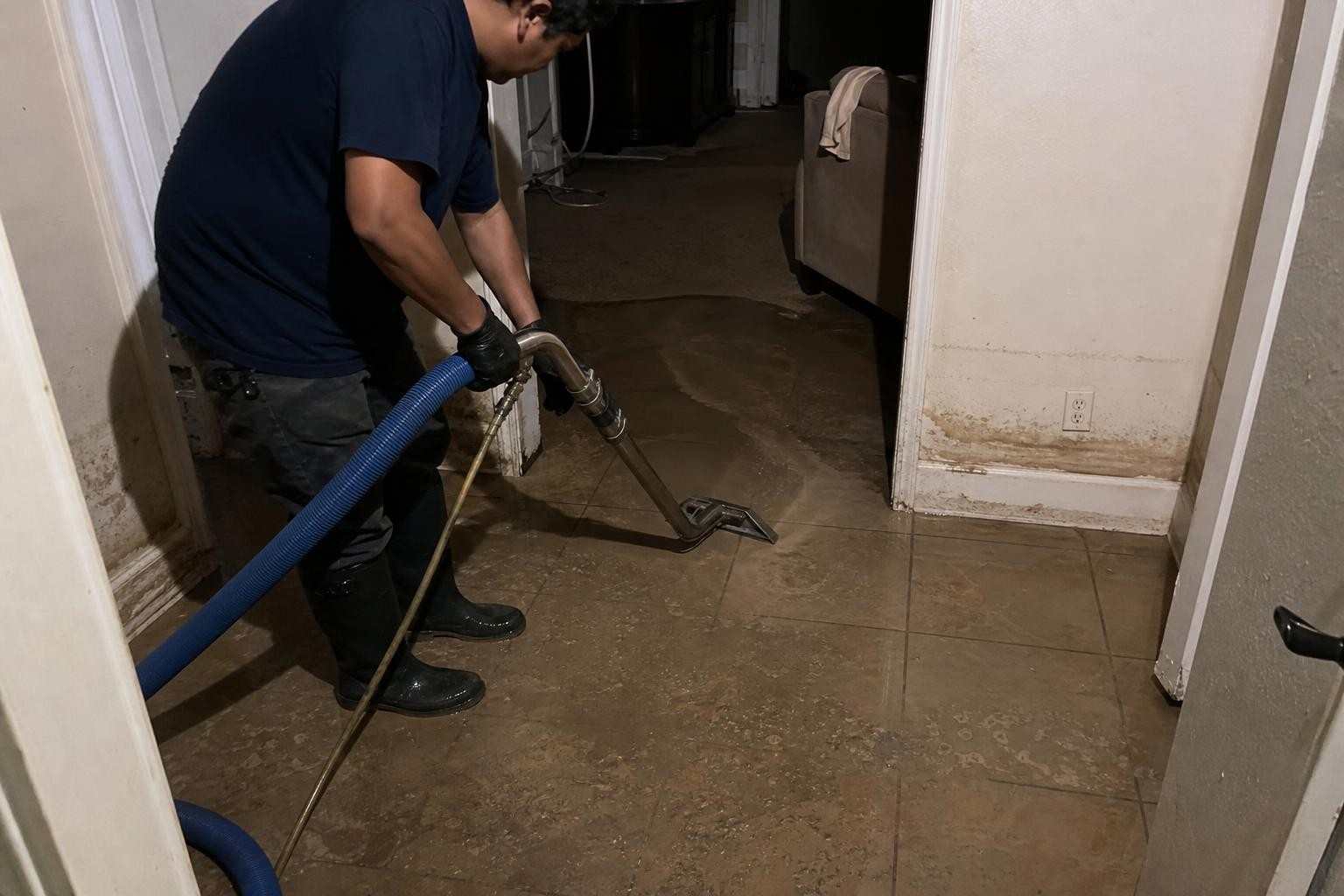
Between truck-mounted units and submersible pumps, standing water leaves a Richardson home in a fraction of the time any household wet-vac would take. Some people call this water mitigation or water cleanup, and it is where every Richardson water restoration and water damage repair job starts.
Water extraction in Richardson TX →24/7 Emergency Water Removal
A pipe that ruptures before dawn or a slab leak inching across the kitchen has no regard for business hours. Our line stays open around the clock and a crew points toward Richardson the moment you call. We take 24 hour water damage calls across Richardson, and that 24/7 water damage line never goes to voicemail.
Emergency water removal in Richardson TX →Flood Damage Restoration
Let Duck Creek or Cottonwood Creek top its banks, or a storm drain back up, and a flooded home calls for full extraction, structural drying, and cleanup. We carry Richardson flood jobs from soaked to sound. From flood cleanup through the flood damage repair that follows, we carry a flooded Richardson home from soaked to sound.
Flood damage restoration in Richardson TX →Sewage Cleanup & Sanitization
A backed-up sewer line rates as a Category 3 biohazard, far beyond anything a mop should touch. We contain it, remove it, disinfect the space, and clear the lingering odor across Richardson. Our sewage backup cleanup covers full sewage removal and black water cleanup.
Sewage cleanup in Richardson TX →Commercial Water Damage
Offices, labs, and retail suites along the Telecom Corridor and around CityLine. We get the water off your floor and help you keep the doors open through it.
Commercial water damage in Richardson TX →Mold Remediation
Dampness trapped in a wall gives mold everything it needs within a day or two. Our TDLR-licensed partners run the containment, removal, and HEPA filtration for Richardson homes.
Mold remediation in Richardson TX →Mold After Water Damage in Richardson
Our push to reach Richardson fast is really a race against mold. It asks for warmth, moisture, and a surface to root into, and a North Texas summer hands over all three at once. A colony can establish itself inside 24 to 48 hours of a leak, tucked behind the drywall or under the flooring where nothing reads as wrong until the smell arrives. Richardson's older houses raise the stakes, since decades-old wall cavities give mold plenty of quiet room to travel. Getting the water up is only the opening move. Extraction with no real drying behind it simply locks the dampness into the wall.
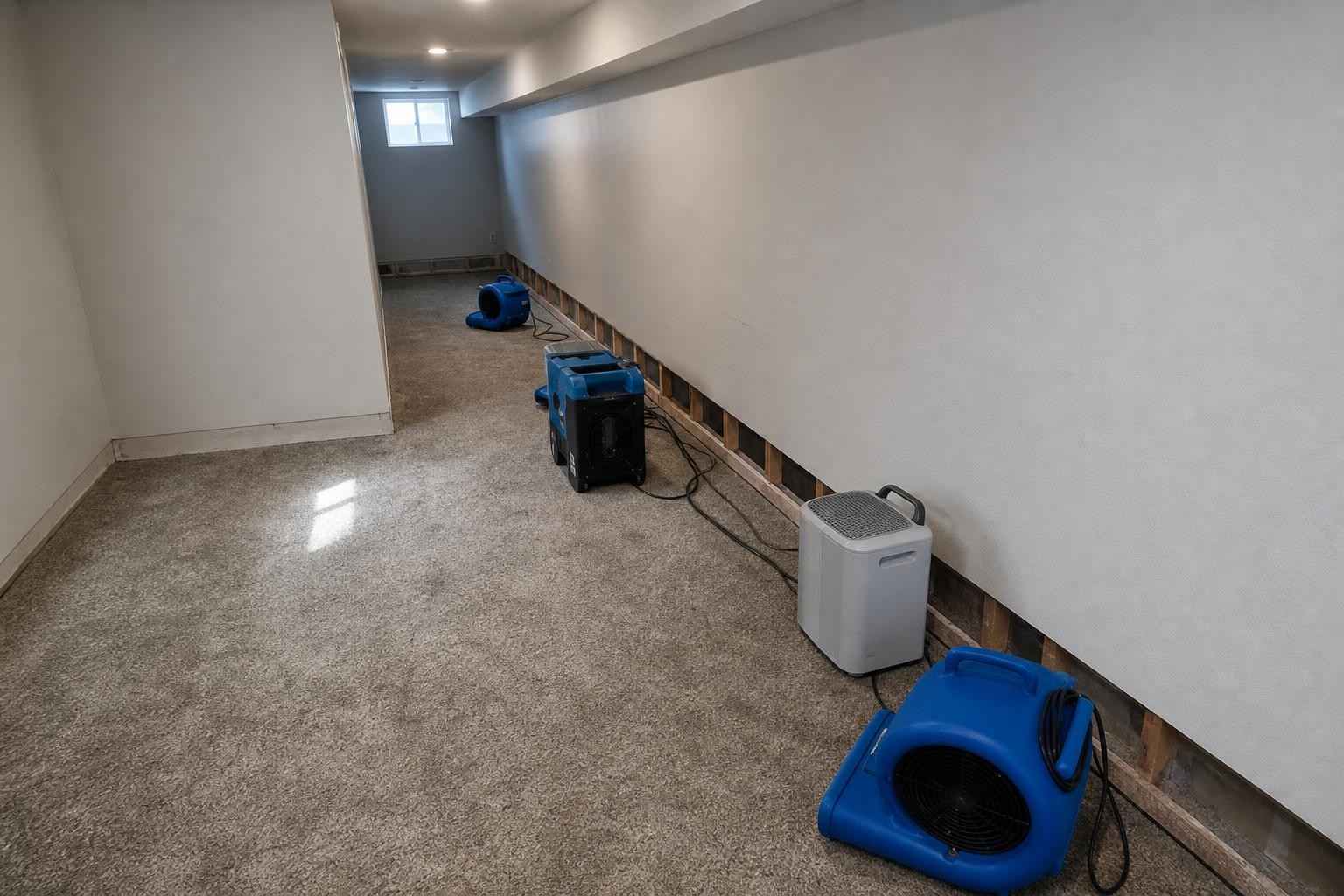
That is why drying earns its own dedicated stage on every Richardson job. We set commercial air movers and dehumidifiers on the structure, then return to the concealed pockets with moisture meters and thermal imaging to verify they have genuinely reached dry, not merely the surface a hand can feel. Where mold has already begun, our mold remediation partners take over the removal and treatment.
Mold remediation and removal services are performed by or in partnership with a TDLR-licensed Mold Remediation Contractor. We do not perform mold testing, inspection, or assessment, remediation and removal only.
Neighborhoods & ZIP Codes We Serve in Richardson
We take water damage calls everywhere in Richardson TX, from the Canyon Creek streets on the east side to the midcentury blocks west of Central Expressway, every ZIP code, at any hour of the day or night.
Richardson TX Neighborhoods
Richardson TX ZIP Codes
We also serve neighboring Plano, Garland, Dallas, Sachse, and Addison. View all service areas →
Official Richardson TX Resources