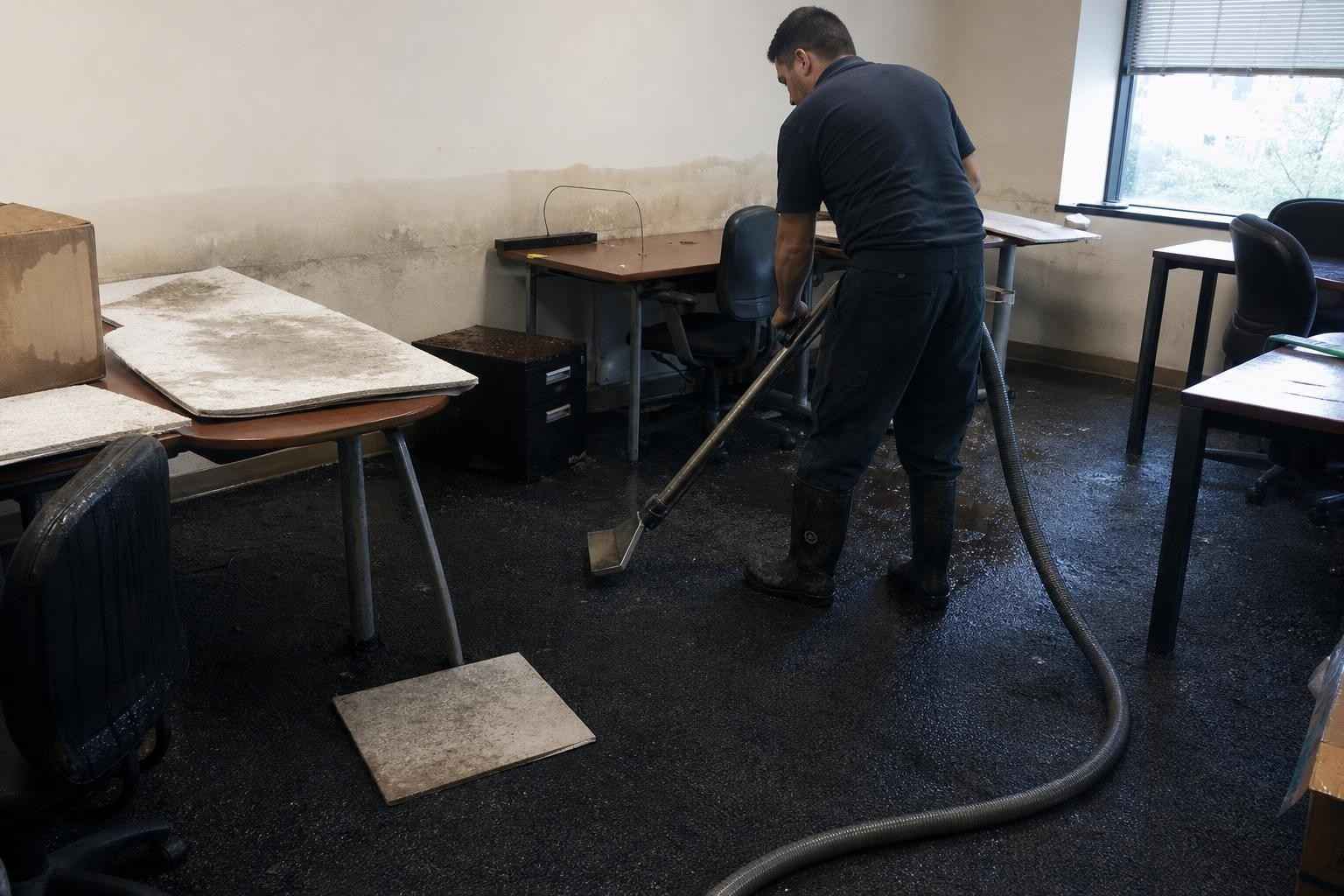
Plano water damage most often comes from slab leaks under Collin County's expansive clay, aging 1980s to 2000s supply lines now 25 to 45 years old, and flooding along Rowlett Creek and Spring Creek. Our crews pump out the water and dry the framing. Call (469) 804-9910 for 24/7 emergency response.
Across Plano, the wider Dallas water damage restoration service means water out fast and framing dried right.
Water Damage Restoration in Plano, TX
Most Plano homeowners meet water damage at 2 a.m., not noon. Maybe a supply line behind the washer splits while the house sleeps, maybe a slab leak finally forces its way up through the kitchen tile, maybe a Collin County thunderstorm drives runoff back through a floor drain. Whichever it is, the water does not sit still. It wicks along the baseboards, climbs the drywall by capillary action, and pools in the subfloor where no one thinks to check until the smell arrives. Add a humid Texas afternoon and mold has what it needs to colonize, sometimes before the next morning.
Water Damage Restoration Dallas answers Plano emergency calls around the clock, holidays and weekends included. Because our shop sits in Dallas, roughly ten miles south of most Plano addresses, a crew is usually en route before you have finished mopping the first towel. Your call reaches a person who dispatches, not a recording. That first truck carries mounted extraction, commercial dryers, and the timestamped photos and moisture logs your insurance adjuster will request, so nothing has to be redone on a second visit. Dial (469) 804-9910 for a straight answer on our arrival window.
⚠️ Why Plano Homes Face Elevated Water Damage Risk
The same master-planned buildout that made Plano famous also set the timer on its plumbing. Subdivisions filled in wave after wave from the 1980s through the 2000s, so a big share of the city now sits on supply lines somewhere between 25 and 45 years old, exactly the age band where copper thins, pinholes open, and soldered joints let go. Below the slabs lies the expansive clay that defines Collin County: it heaves upward after a soaking rain, then contracts hard through a Texas drought. Every cycle tugs on the pipes cast into the foundation, and that is precisely why slab leaks headline our Plano dispatch log. Factor in Rowlett Creek and Spring Creek winding through town, the once-a-winter freeze that ruptures an exposed line, and cooling systems that run five months straight, and a Plano household faces several separate paths to a flooded floor.
Plano's Specific Water Damage Risks
Every soaked floor has its own backstory, and pinning that story down is what tells us how to dry it out. Here are the situations that pull our crews toward Plano week after week:
- Creek and stormwater flooding. With Rowlett Creek and Spring Creek both threading through the city, a heavy cell parked over Plano can shove either one over its banks into the low-lying yards pressed against them. Plano's own drainage office warns that stormwater can back up well past the mapped floodplain, so it takes nothing more than a leaf-choked inlet or a ponding cul-de-sac to run water under your door.
- Slab leaks under a shifting foundation. Plano's clay is restless year-round, and the water lines poured into your slab absorb every inch of that movement. Watch for a warm stripe underfoot, a water bill creeping up with nothing to explain it, or a faint trickle you can hear only when the house goes silent; any one of those usually means a line beneath the concrete has already failed.
- Aging plumbing in the established neighborhoods. Around Los Rios, Hunters Glen, and the other streets that filled in from the 1980s into the early 2000s, plenty of houses still run their factory supply lines. Decades underground leave that pipe corroded, thinned, and prone to weeping at the fittings.
- Frozen and burst pipes. Recall how the February 2021 freeze sat on North Texas for days; in Plano the casualties clustered where insulation runs thin, meaning uninsulated attics, detached garages, and lines chased through exterior walls.
- Summer AC condensate overflow. Five months of nonstop cooling puts a lot of mileage on a Plano air handler. When a condensate line clogs or a drain pan rusts through, the overflow feeds a ceiling stain or a soaked closet under an upstairs unit, quietly, for days before anyone spots it.
- Appliance and water heater failures. A cracked washer hose, a loose dishwasher fitting, or a corroded water heater tank tends to fail on its own schedule, releasing water for hours while the family is at work or asleep down the hall.
Water Damage Services We Provide in Plano
The trigger changes, but our objective for a Plano property never does: evacuate the water while it is still moving, salvage and clean whatever it reached, and drive the structure down to a moisture reading we can put a number on. Below is everything we handle across the city.
Water Extraction
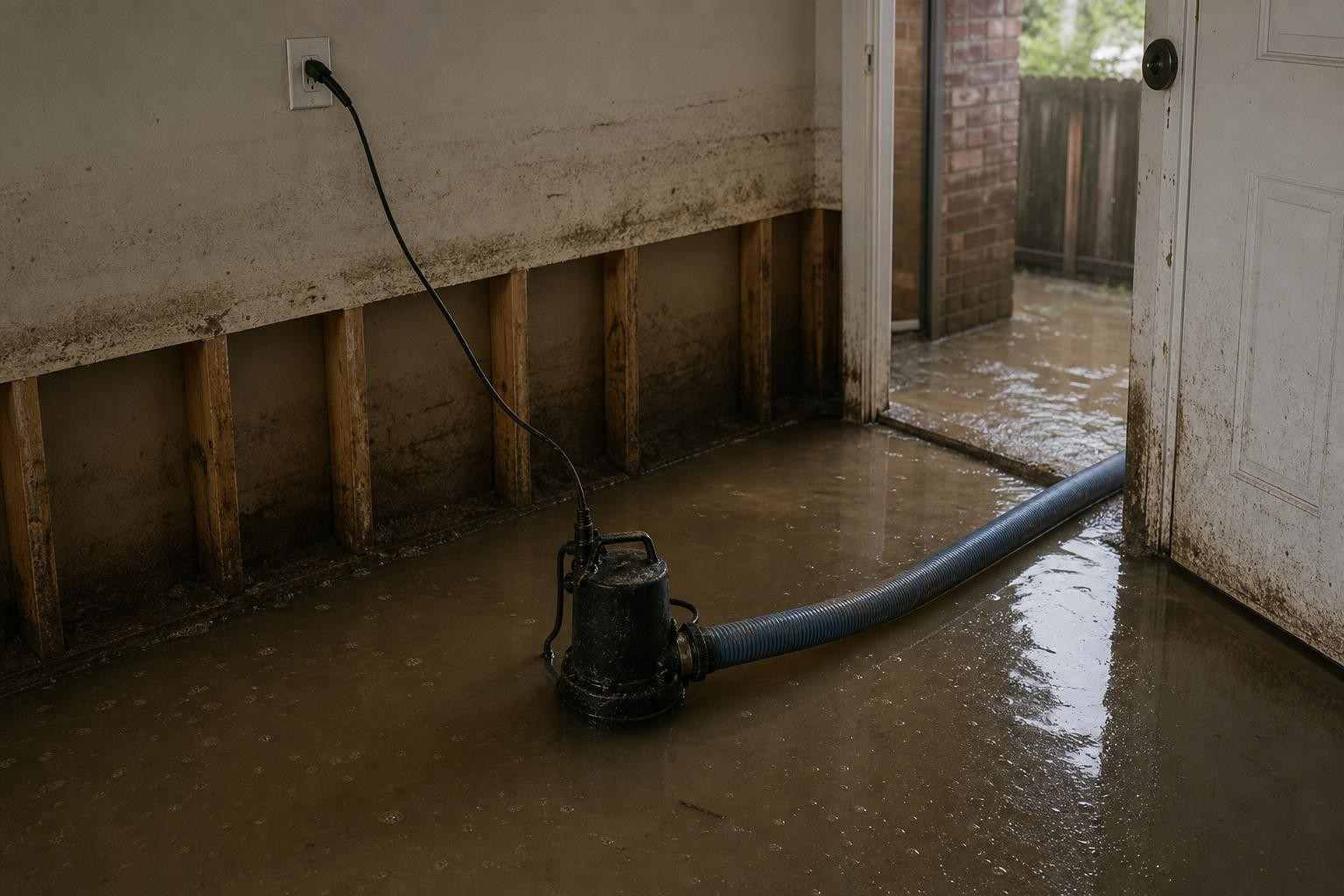
Mounted extraction rigs paired with submersible pumps lift standing water out of a Plano home far quicker than any rented wet-vac could hope to. Some people call this water mitigation or water cleanup, and it is where every Plano water restoration and water damage repair job starts.
Water extraction in Plano TX →24/7 Emergency Water Removal
A pre-dawn pipe burst or a slab leak spreading across the kitchen refuses to keep office hours, so neither do we. Call any hour and a crew starts toward Plano. We take 24 hour water damage calls across Plano, and that 24/7 water damage line never goes to voicemail.
Emergency water removal in Plano TX →Flood Damage Restoration
Whether Rowlett Creek jumps its banks or a Plano storm drain backs up, a flooded home needs total extraction, structural drying, and cleanup. We carry those jobs from soaked to sound. From flood cleanup through the flood damage repair that follows, we carry a flooded Plano home from soaked to sound.
Flood damage restoration in Plano TX →Sewage Cleanup & Sanitization
A sewer backup is Category 3 biohazard territory, not something a mop settles. We isolate it, extract it, disinfect the affected footprint, and clear the odor for good. Our sewage backup cleanup covers full sewage removal and black water cleanup.
Sewage cleanup in Plano TX →Commercial Water Damage
From Legacy West offices to Willow Bend storefronts, we clear water off a commercial floor and get you back to serving customers with the least downtime possible.
Commercial water damage in Plano TX →Mold Remediation
Any moisture left behind becomes mold food within a day or two. Our TDLR-licensed partners run containment, removal, and HEPA filtration for Plano properties.
Mold remediation in Plano TX →Mold After Water Damage in Plano
Speed matters in Plano for one blunt reason: a Collin County summer is a mold incubator. Spores need warmth, standing moisture, and a surface to anchor to, and July delivers all three by lunchtime. That is why a colony can establish inside 24 to 48 hours of a leak, typically hidden behind drywall or beneath flooring where the first clue is a smell, not a stain. Extracting the visible water only clears the opening act; leave the cavity damp and you have effectively bricked the moisture inside the wall.
For that reason we score drying as a full phase, never a formality. We run air movers and dehumidifiers on the structure, then verify the result with moisture meters and thermal cameras that read the concealed pockets, not just the surface your hand can reach. Should mold already have a foothold, our mold remediation partners take over the removal and treatment.
Mold remediation and removal services are performed by or in partnership with a TDLR-licensed Mold Remediation Contractor. We do not perform mold testing, inspection, or assessment, remediation and removal only.
Neighborhoods & ZIP Codes We Serve in Plano
We take water damage calls everywhere in Plano TX, from the Legacy West corridor out to the established neighborhoods east of Central Expressway, every ZIP code, every hour of the day.
Plano TX Neighborhoods
Plano TX ZIP Codes
We also serve neighboring Frisco, Allen, McKinney, Richardson, and Carrollton. View all service areas →
Official Plano TX Resources