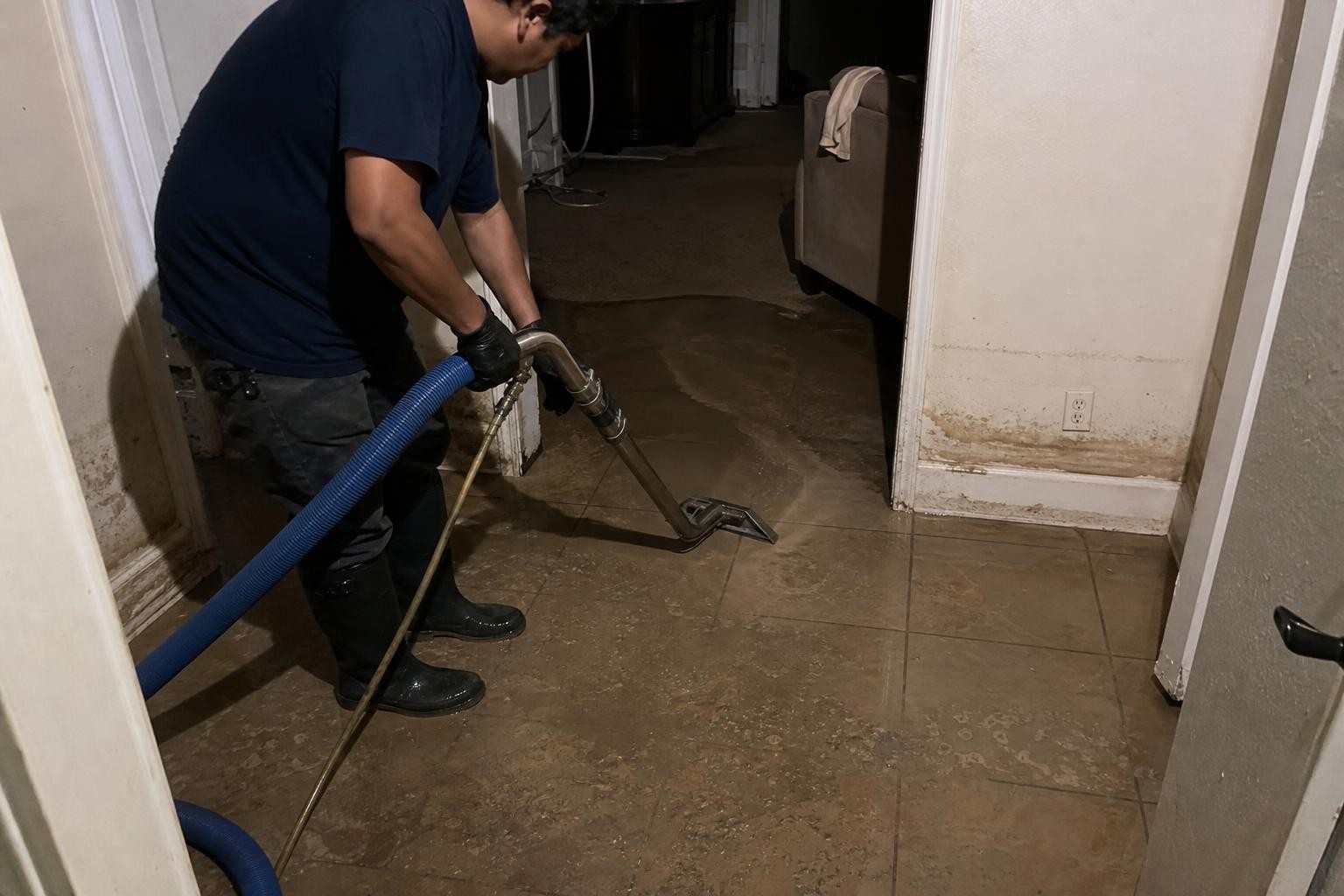
Allen homes flood from slab leaks under Houston Black clay, corroding 1990s and 2000s supply lines, and Cottonwood or Rowlett Creek overflow within the Rowlett Creek watershed. Our technicians pump out the water, dry the framing, and document every claim as the work goes. Call (469) 804-9910.
Behind every Allen job stands our main Dallas water damage restoration operation, the same people and gear we run metro wide.
Water Damage Restoration in Allen, TX
The moment you notice water where it should not be, the clock that matters most is not the one on your drying equipment. It is the one on your insurance claim. An Allen homeowner who reacts fast and hands the adjuster a clean set of photos, moisture readings, and dated logs tends to walk away reimbursed. The one who mops up first and calls later, with nothing written down, often argues over what was actually damaged. We work the Allen side of the Metroplex with both clocks in mind: stop the water and dry the structure, yes, but build the file that gets the claim paid at the same time.
Water Damage Restoration Dallas answers Allen calls every hour of the day, weekends and holidays included. Our base is in Dallas, roughly 20 miles down US 75, so the technician heading up to you is already on the corridor instead of crossing the whole region to get there. You reach a person, not a phone tree, and the crew shows up on the first trip carrying truck-mounted extraction, commercial drying gear, and a camera. Dial (469) 804-9910 and we will tell you plainly how soon we can be standing in your driveway.
⚠️ Why Allen Homes Face Elevated Water Damage Risk
Allen grew up in a hurry. It jumped from a few thousand residents in the 1970s to well past 100,000, and most of that construction landed in the 1990s and 2000s. That timeline matters for your plumbing: a large slice of Allen homes now run supply lines 20 to 35 years old, right in the window where copper joints start to weep and crack. Underneath sits Houston Black clay, an expansive soil that swells after a soaking and shrinks back hard through a Texas drought, and every one of those cycles grinds on the lines cast through the slab. Layer in the Cottonwood and Rowlett Creek corridors that thread the city, the occasional hard freeze that splits an exposed pipe, and cooling systems that run nonstop from May into September, and a soaked floor rarely has just one likely cause here.
What Puts Allen Homes at Risk
How the water got in shapes both the cleanup and the claim, so we sort the source before anything else. Four situations account for most of what pulls us up to Allen:
- Slab leaks under the shifting clay. Houston Black clay never settles, and the lines poured into your foundation absorb that movement year after year. A patch of floor that stays warm, a water bill climbing for no reason, or a faint hiss when the house is quiet usually means a line under the slab has already failed.
- Aging plumbing in the growth-era streets. Much of Allen, from Watters Crossing through the Twin Creeks subdivisions, still runs on the supply lines it was built with. Two or three decades in, that pipe corrodes, throws pinhole leaks, and seeps quietly at the joints behind the drywall.
- Creek and stormwater flooding. Cottonwood Creek runs north to south through the middle of Allen and Rowlett Creek drains the western edge, both part of the 137-square-mile Rowlett Creek watershed shared with Plano and McKinney. A hard rain can push either channel into the backyards pressed against the greenbelts, and a clogged inlet can slide water under a door well away from any mapped flood line.
- Freeze breaks and appliance failures. A February 2021-style cold snap splits pipes in attics, garages, and exterior walls across Allen overnight. And a worn washer hose, dishwasher fitting, or tired water heater can run for hours in an empty house, with the worst damage falling to the floor below in Allen's many two-story layouts.
How We Document an Allen Water Claim
Insurers in Texas do not pay for what they cannot see, and by the time an adjuster reaches your Allen home the water is usually gone and the drying is underway. That gap is exactly where claims stall. So before a single air mover switches on, we walk the loss with a camera and moisture meters and capture the damage at its worst, while it still tells the story of what happened. What the wall looked like soaked, how far the water tracked from the source, which readings came off the framing and the subfloor on day one.
From there the record keeps building on its own schedule. We date every drying log, note the equipment in place and the readings at each visit, and hold the moisture data until the structure hits dry and stays there. When your adjuster asks why a baseboard had to come out or why drying ran the days it did, the answer is already in the file, not a memory anyone has to defend. For a slab leak or a creek backup where cause decides coverage, that paper trail is often what separates a paid claim from a fight.
- Source and scope, photographed first. Where the water originated, how the category grades, and the full reach of the moisture, captured before cleanup changes the scene.
- Dated moisture logs. Meter readings off framing, subfloor, and drywall at every visit, tracked from the first reading to verified dry.
- An adjuster-ready package. Photos, drying records, and equipment notes assembled the way a Texas carrier expects to receive them.
Water Damage Services We Provide in Allen
Whatever left the house wet, the work runs the same way: clear the water off the floor fast, save what it reached, and dry the structure to a number we can stand behind. Here is the full range we run for Allen property owners.
Water Extraction
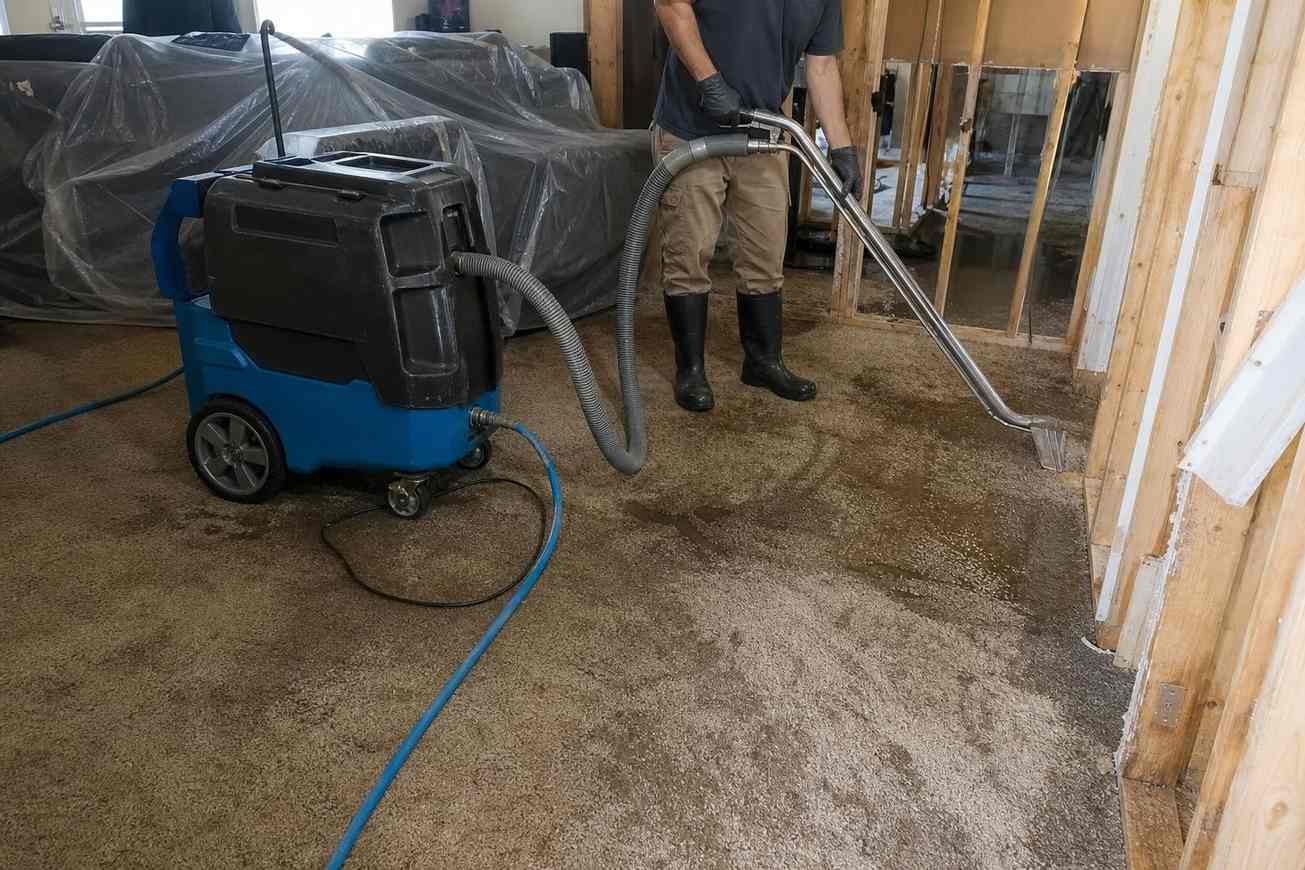
Portable and truck-mounted extractors, backed by submersible pumps for the deep water, empty an Allen home far faster than any shop vac ever could. Some people call this water mitigation or water cleanup, and it is where every Allen water restoration and water damage repair job starts.
Water extraction in Allen TX →24/7 Emergency Water Removal
A supply line that lets go before sunrise or a slab leak spreading across the kitchen does not keep office hours, and neither do we. Call any time and a crew starts rolling toward Allen. We take 24 hour water damage calls across Allen, and that 24/7 water damage line never goes to voicemail.
Emergency water removal in Allen TX →Flood Damage Restoration
When Cottonwood Creek jumps its banks or a storm inlet backs up, a flooded home needs full extraction, structural drying, and cleanup. We take Allen flood jobs from soaked to sound. From flood cleanup through the flood damage repair that follows, we carry a flooded Allen home from soaked to sound.
Flood damage restoration in Allen TX →Sewage Cleanup & Sanitization
A backed-up sewer line is a Category 3 biohazard, well past anything a mop can touch. We contain it, remove it, disinfect the space, and clear the odor across Allen. Our sewage backup cleanup covers full sewage removal and black water cleanup.
Sewage cleanup in Allen TX →Commercial Water Damage
Offices, shops, and the retail clustered around Watters Creek and the US 75 corridor. We clear the water off your floor and help keep the doors open.
Commercial water damage in Allen TX →Mold Remediation
Moisture left in the walls hands mold a start within a day or two. Our TDLR-licensed partners handle containment, removal, and HEPA filtration for Allen homes.
Mold remediation in Allen TX →Mold After Water Damage in Allen
The reason we push so hard on drying is the local climate. Mold needs warmth, moisture, and something to grow on, and a Collin County summer supplies all three. Growth can take hold within a day or two of a leak, almost always hidden behind the drywall or under the flooring, where the first sign is a smell rather than a stain. Extracting the standing water only handles the visible half. Stop there and skip the deep drying, and you have sealed damp air inside the wall cavity with the framing to feed on.
That is why we treat drying as its own stage rather than a quick finish. We bring the structure down with drying equipment, then come back with moisture meters and thermal imaging to confirm the hidden pockets read dry, not only the surface a hand can reach. If mold has already taken hold, our mold remediation partners step in to handle the removal and treatment.
Mold remediation and removal services are performed by or in partnership with a TDLR-licensed Mold Remediation Contractor. We do not perform mold testing, inspection, or assessment, remediation and removal only.
Neighborhoods & ZIP Codes We Serve in Allen
We take water damage calls all over Allen TX, from the Twin Creeks subdivisions and Watters Crossing on the west side to the established streets and newer builds east of US 75, both ZIP codes, every hour of the day.
Allen TX Neighborhoods
Allen TX ZIP Codes
We also serve neighboring Plano, McKinney, Frisco, Fairview, and Lucas. View all service areas →
Official Allen TX Resources