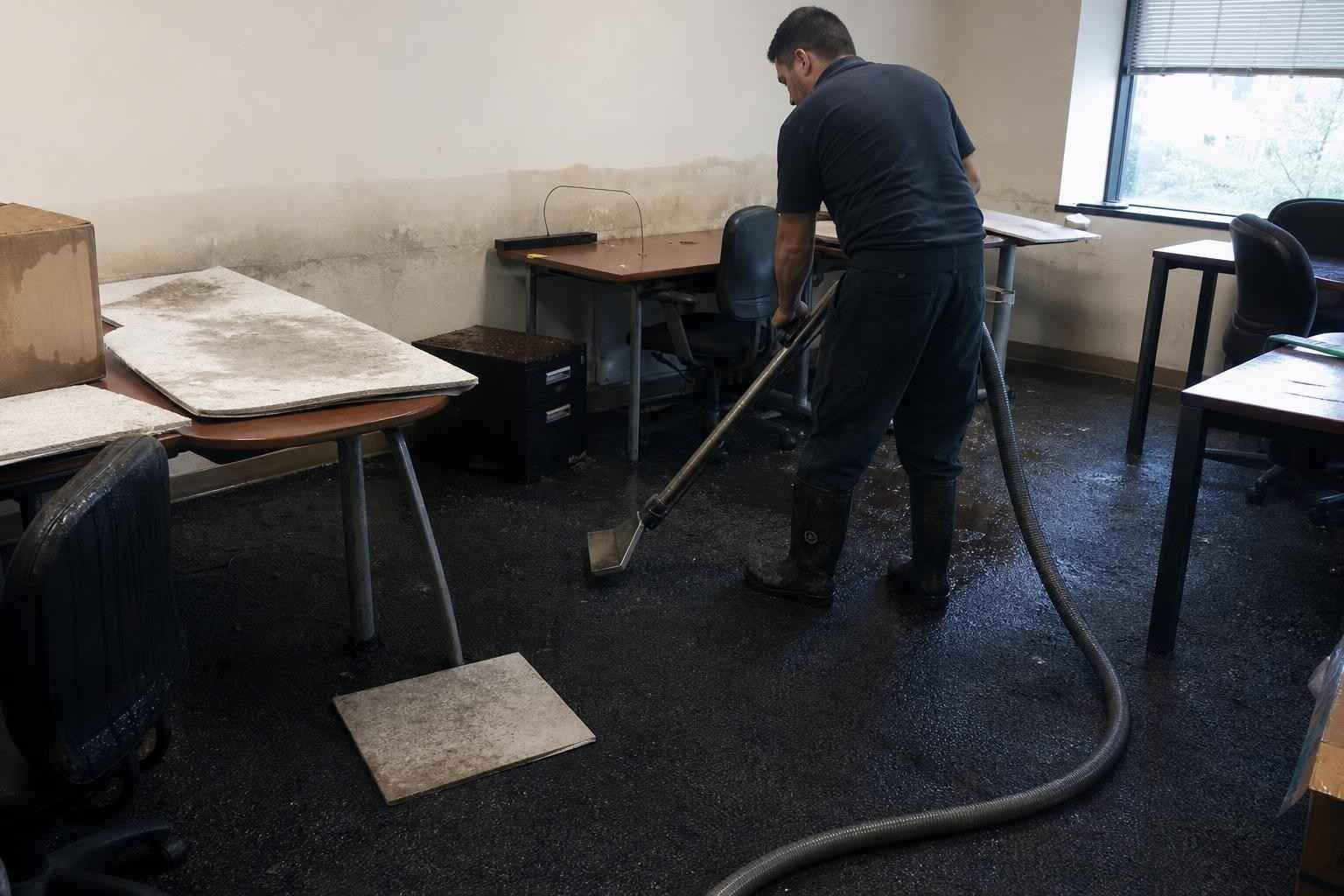
Grand Prairie is boxed in by water, so homes flood from Joe Pool Lake, Mountain Creek Lake, the West Fork of the Trinity, and Johnson, Fish, and Cottonwood Creeks, on top of slab leaks under expansive clay. Our crews extract the water and dry the structure. Call (469) 804-9910 for 24/7 response.
Across Grand Prairie, our main Dallas water damage restoration operation means water out fast and framing dried right.
Water Damage Restoration in Grand Prairie, TX
Grand Prairie is a hard city to keep dry. It stretches nearly twenty miles from Joe Pool Lake in the south up past Mountain Creek Lake, with the West Fork of the Trinity and a tangle of creeks cutting through the middle, and a lot of homes sit on ground that was never far above the water table to begin with. So when a supply line lets go behind a Mira Lagos wall at two in the morning, or a slab leak works its way up through the tile of a Dalworth Park ranch, the water does not sit politely and wait. It runs the baseboards, climbs the drywall, and settles into the subfloor while the carpet on top still feels bone dry to the touch.
That is the trouble with waiting to see how bad it gets. By the time a stain shows or the floor starts to give, the damage has usually spread well past what you can see. We take Grand Prairie calls at any hour, weekends and holidays included, and the crew arrives on the first trip with truck-mounted extraction, commercial drying gear, and the moisture readings and photos your adjuster will end up asking for. Call (469) 804-9910 and a real person will tell you how soon a technician can be at your door.
⚠️ Why Grand Prairie Homes Face Elevated Water Damage Risk
Few Metroplex cities carry as much water on their doorstep as Grand Prairie. The city runs roughly twenty miles north to south across three counties, boxed in by Joe Pool Lake at the south end, Mountain Creek Lake to the north, and the West Fork of the Trinity River, with Johnson Creek, Fish Creek, and Cottonwood Creek threading the middle. All that low ground is why the city requires a floodplain permit for any work within 200 feet of a mapped floodplain, since so many lots sit right against that line. Beneath every neighborhood lies the expansive clay common to North Texas, soil that balloons after a soaking rain and pulls back hard through a drought, tugging at the water lines cast into your slab with each swing. Layer on a housing mix that spans 1950s ranch homes in the north end and newer lakeside builds around Mira Lagos, the winter freezes that split exposed pipe, and summers that never give the AC a rest, and a homeowner here is exposed from several directions at once.
Grand Prairie's Specific Water Damage Risks
How we work a job depends heavily on where the water started. In Grand Prairie the source usually lands in one of a handful of patterns, and these are the ones that keep our crews busiest:
- Lake and river flooding. Between Joe Pool Lake to the south, Mountain Creek Lake to the north, and the West Fork of the Trinity plus Johnson, Fish, and Cottonwood Creeks running through town, a hard rain has no shortage of places to spill over. A clogged storm inlet or a street that ponds can slide water under a door on lots that never appear on a flood map, and the mapped floodplain alone touches a wide slice of the city.
- Slab leaks under shifting clay. The clay below Grand Prairie is forever on the move, and the copper and PEX lines cast into your foundation absorb every bit of it. A stretch of floor that stays oddly warm, a water bill inching up for no reason, or a faint trickle you only catch when the house goes quiet usually means a line has already opened up.
- Old pipe in the north-end neighborhoods. Through the mid-century streets around Dalworth Park and the older blocks near the Great Southwest district, a lot of homes still run their original galvanized and copper supply line, now thinned by decades of corrosion and prone to pinholes or a split at the joint.
- Frozen and burst lines. When a deep freeze settles over North Texas the way the February 2021 storm did, the pipes in uninsulated garages, attics, and exterior walls are the first to give. A single overnight split can flood a room before anyone is up to shut the valve.
- Summer condensate overflow. Push an air conditioner flat out through a Grand Prairie July and a plugged condensate line or a rusted drain pan eventually spills over, quietly feeding a stain into a ceiling or the closet under a second-floor air handler for days before it surfaces.
- Appliance and water heater failures. A cracked dishwasher fitting, a brittle washer hose, or a water heater near the end of its run can pour water for hours while the house sits empty, and the damage is long done before anyone walks back in.
Water Damage Services We Provide in Grand Prairie
Whether the water rolled in off Joe Pool Lake or welled up from a slab leak in a Mira Lagos hallway, the objective holds steady across every Grand Prairie job: get it off the floor, save what can be saved, and dry the wood and drywall until a meter agrees. Here is the full range we cover for property owners across the city's three-county footprint.
Water Extraction
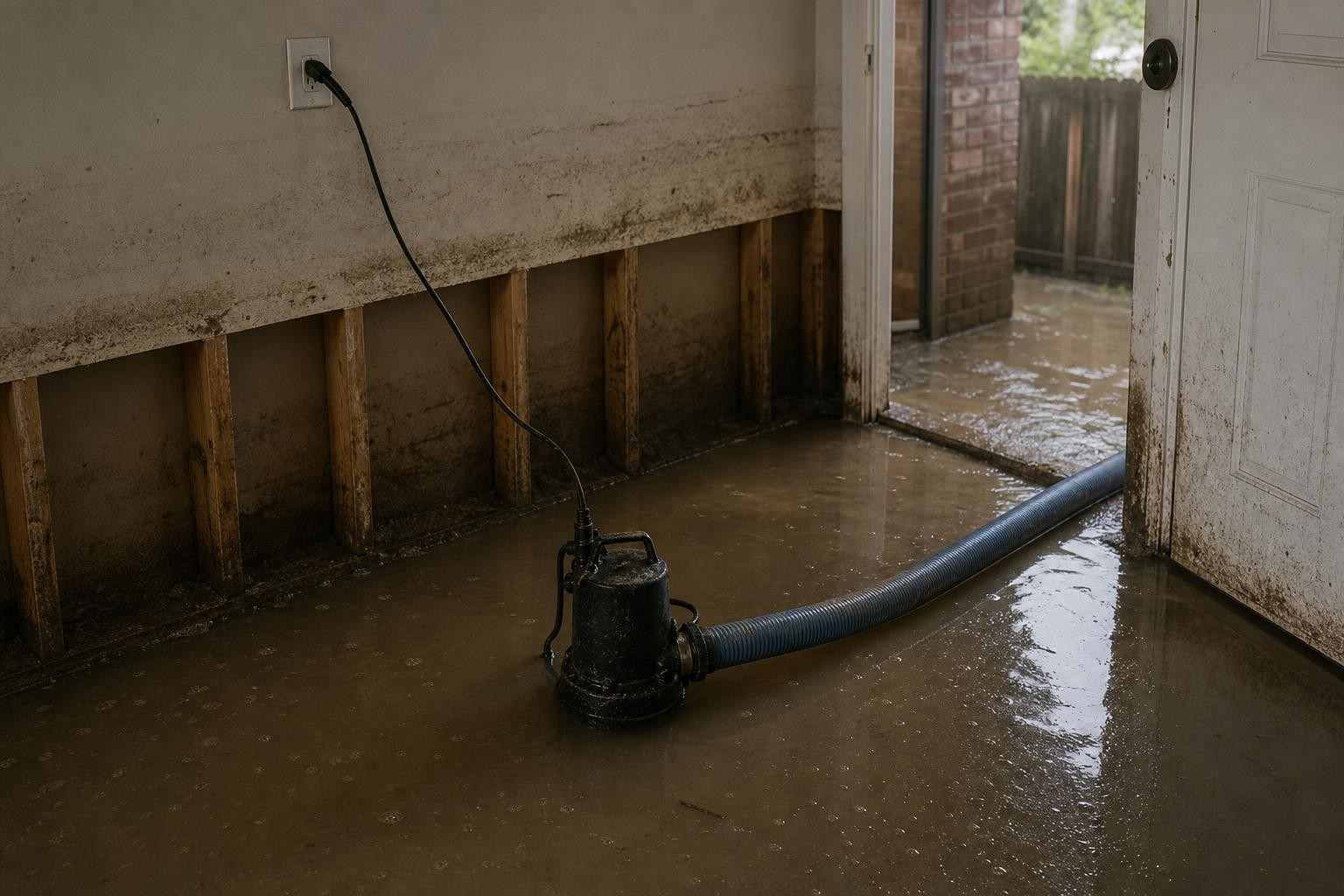
Truck-mounted units and submersible pumps clear a soaked Grand Prairie floor in a fraction of the time a garage wet-vac would take, which matters on a slab that keeps feeding water back up. Some people call this water mitigation or water cleanup, and it is where every Grand Prairie water restoration and water damage repair job starts.
Water extraction in Grand Prairie TX →24/7 Emergency Water Removal
Water lines here rupture on their own schedule, often overnight, and a leak spreading toward the baseboards will not pause for business hours. Reach us at any hour and a Grand Prairie crew starts moving. We take 24 hour water damage calls across Grand Prairie, and that 24/7 water damage line never goes to voicemail.
Emergency water removal in Grand Prairie TX →Flood Damage Restoration
Let the West Fork or one of the creeks near Joe Pool Lake climb, or a storm inlet overwhelm, and a flooded house wants the whole sequence: extraction, structural drying, cleanup. We carry Grand Prairie flood jobs from soaked to sound. From flood cleanup through the flood damage repair that follows, we carry a flooded Grand Prairie home from soaked to sound.
Flood damage restoration in Grand Prairie TX →Sewage Cleanup & Sanitization
A sewer backup counts as a Category 3 biohazard, well outside what a mop and bucket should ever meet. Our crews seal the area, haul out the contamination, disinfect what it reached, and clear the odor from Grand Prairie homes. Our sewage backup cleanup covers full sewage removal and black water cleanup.
Sewage cleanup in Grand Prairie TX →Commercial Water Damage
The warehouses of the Great Southwest district, offices along SH 161, and the storefronts by the outlet mall all flood differently than a house. We pull the water and work to keep your Grand Prairie doors open.
Commercial water damage in Grand Prairie TX →Mold Remediation
Left in a wall cavity, moisture off a lakeside leak gives mold its opening within a day or two. Our TDLR-licensed partners run containment, removal, and HEPA filtration for Grand Prairie homes.
Mold remediation in Grand Prairie TX →What to Do Before Our Crew Reaches Grand Prairie
The minutes between your call and the truck pulling up are worth using. If it is safe to do so, a few quick moves can keep the loss from growing while we are en route to your Grand Prairie home:
- Kill the water at the source. Shut the valve under the fixture that failed, or close the main out by the meter if you cannot tell where it is coming from. On a slab leak you may not stop it entirely, but every gallon you hold back is one less to pull out later.
- Cut the power to soaked rooms. If water is anywhere near outlets, cords, or a panel, flip the breaker to those rooms before you step in. Skip this and stay clear if reaching the panel means wading through the water.
- Lift what you still can. Get rugs, electronics, and anything with legs up off a wet floor, and slide foil or wood blocks under furniture feet so the finish does not bleed into damp carpet.
- Start the photos early. Snap the standing water and the damage before anything is moved or mopped. Those first shots carry real weight with a Grand Prairie adjuster later, and we add our own readings to them on arrival.
- Leave the hidden wet alone. Do not tear into drywall or rip up flooring hoping to help. Pulling material the wrong way can spread contamination or wreck what could have been dried and saved, so let the crew scope it first.
Mold After Water Damage in Grand Prairie
Speed matters in Grand Prairie because of what the lake air does to a wet house. Warmth, trapped moisture, and something organic to grow on are all mold needs, and a July spent between Joe Pool Lake and Mountain Creek Lake hands it the whole recipe. From that starting point a colony can be established a day or two after the leak, tucked behind drywall or beneath a floor where you catch the musty smell well before any stain appears. Pulling out the standing water only clears the visible half of the problem. Skip the deep drying and the damp simply stays locked in the wall, quietly working on the framing.
So on a Grand Prairie job, drying is a stage we run and verify, not a formality tacked onto the end. Air movers and dehumidifiers stay on the structure, and then we return with moisture meters and thermal imaging to prove the pockets you cannot reach have actually hit dry rather than just the surface under a palm. If mold already has a foothold by the time we arrive, our mold remediation partners take the removal and treatment from there.
Mold remediation and removal services are performed by or in partnership with a TDLR-licensed Mold Remediation Contractor. We do not perform mold testing, inspection, or assessment, remediation and removal only.
Neighborhoods & ZIP Codes We Serve in Grand Prairie
We take water damage calls across all of Grand Prairie TX, from the lakeside subdivisions near Joe Pool Lake to the older streets in the north end and the industrial blocks around the Great Southwest district, every ZIP code, any hour of the day.
Grand Prairie TX Neighborhoods
Grand Prairie TX ZIP Codes
We also serve neighboring Arlington, Irving, Cedar Hill, Duncanville, and Dallas. View all service areas →
Official Grand Prairie TX Resources